Factory-direct structural racking and high-density automated systems manufactured in Shandong, China.
An authoritative technical analysis of moment distribution, arm deflection parameters, structural steel profiles, and load safety factors.
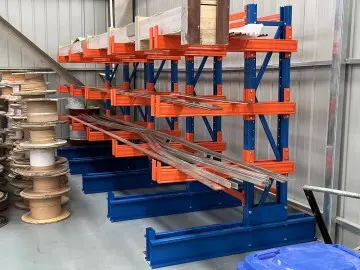
Cantilever storage systems represent the premier structural engineering methodology for handling non-standard, long-length, cylindrical, and rigid sheet items. Unlike conventional selective pallet racking—which relies on front vertical uprights that constrain horizontal storage width—a cantilever system uses central vertical columns bolted to heavy floor bases, extending horizontal arms outward without front structural obstruction. This design creates a continuous horizontal storage plane capable of accommodating loads ranging from extruded aluminum channels and steel pipes to raw timber and aerospace composite panels.
From a structural mechanics perspective, cantilever systems convert downward gravitational loads from cantilevered arms into significant bending moments ($\mathbf{M}$) and axial compression forces ($\mathbf{P}$) within the vertical columns. Proper design requires precise evaluation of arm deflection ratios, column flexural-torsional buckling limits, and connection joint rigidity in compliance with international design codes such as ANSI MH16.2 (RMI standard for cantilever racks) and FEM 10.2.09 (European material handling standard).
Engineering Rule of Thumb: Total System Load Capacity is governingly restricted by the least of three structural thresholds: (1) Arm cantilever bending strength, (2) Connection pin shearing/wedge resistance, and (3) Column overall flexural-torsional buckling strength under combined axial load and un-braced moment distribution.
In a uniformly distributed load ($\mathbf{w}$) scenario across an arm length ($\mathbf{L}$), the maximum deflection ($\mathbf{\delta_{max}}$) at the free tip of a single cantilever arm is calculated using classical Euler-Bernoulli beam theory:
Where:
To preserve structural safety and prevent permanent plastic deformation during heavy dynamic load placement, standard design dictates that maximum tip deflection must not exceed $\mathbf{L / 200}$ under maximum rated static loading. Furthermore, high-capacity industrial designs utilize a tapered arm geometry—where the arm profile cross-section depth gradually decreases from column connection to tip—optimizing weight distribution while aligning section modulus ($\mathbf{Z_x}$) directly with the parabolic moment gradient.
China manufacturers generally categorize cantilever racking into two fundamental structural steel manufacturing routes:
| Structural Component | Cold-Formed Roll-Formed Profile (Light/Medium) | Hot-Rolled Structural H-Beam (Heavy Industrial) |
|---|---|---|
| Steel Grade | Q235B Cold-Rolled Coils (Yield Strength ≥ 235 MPa) | Q355B / Q355D Hot-Rolled Structural Steel (≥ 355 MPa) |
| Arm Load Capacity | 100 kg to 600 kg per arm | 500 kg to over 3,500 kg per arm |
| Impact Resistance | Moderate; prone to localized denting under forklift impact | Extremely High; thick flange sections resist forklift collision |
| Arm Connection Type | Hook-in teeth / Pin-lock adjustable pitch (50mm / 75mm) | Bolted heavy-gauge connector plates / High-tensile 8.8 grade bolts |
| Best Application | Light plastic pipes, light lumber, tubing, PVC extrusions | Structural steel beams, heavy copper coils, oil field pipes, sheet plates |
Why Shandong's industrial cluster yields unparalleled lead-time predictability, raw material cost efficiency, and structural quality control.
Guake Logistics Technology is headquartered in Shandong, China—the epicenter of global structural steel manufacturing. Direct proximity to tier-1 steel mills (BaoSteel, Shandong Iron & Steel Group) ensures instant access to prime Q235B and Q355B certified steel coils and H-beams with full material traceability (EN 10204 3.1 Mill Test Certificates).
Our 20,000+ m² facility features continuous cold roll-forming production lines, ultra-fast fiber laser cutting for heavy connector plates, multi-axis robotic welding cells, and an eco-friendly automated electrostatic powder coating line ensuring uniform 60–90 µm dry-film epoxy-polyester coating thickness.
Production runs undergo rigorous quality controls: ultrasonic flaw detection on column-base load welds, salt spray testing for corrosion resistance (exceeding 500 hours), and full-scale destructive loading tests to verify ultimate yield margins beyond theoretical FEA simulation.
How specialized cantilever system architectures resolve storage challenges across distinct global industries.
Ideal for storing carbon steel tubes, seamless drill pipes, and copper tubing bundles. Outfitted with heavy-duty solid steel end-pipe stops (removable pins) to prevent cylindrical goods from rolling off arms during crane overhead operations or forklift loading.
Used extensively in commercial lumber mills and building material centers. Continuous shelf decks or steel mesh decking can be mounted across cantilever arms to support variable length wood planks and flexible composite sheets without sagging.
Designed with smooth powder-coated arm finishes or polyurethane rubber arm sleeves to protect soft aluminum alloys, architectural window frame extrusions, and sensitive PVC profiles from surface scratches during high-frequency picking.
Ultra-heavy double-sided H-beam cantilever towers utilized in automotive manufacturing plants and scrap recycling centers to store vehicle chassis frames, heavy stamping dies, and raw sheet steel bundles up to 12 meters in height.
Configured with shed roof attachments and Hot-Dip Galvanization (HDG according to ISO 1461 standard) for external storage yards exposed to rain, snow, salt haze, and harsh environmental conditions.
Custom axle cantilever racks featuring specialized spindle-holding arm cutouts, enabling electrical wire reels and industrial cable drums to rotate smoothly directly on the rack during unwinding operations.
The evolution of heavy material storage: From static steel frames to IoT-monitored automated retrieval environments.
Integration of wireless strain-gauge sensors embedded at arm-to-column connection joints. Real-time telemetry alerts warehouse operators if localized dynamic loading exceeds yield margins or if un-balanced weight distributions threaten structural column stability.
Heavy-duty Cantilever AS/RS (Automated Storage & Retrieval Systems) paired with laser-guided side-loading AGVs or specialized crane forks designed to automatically index long bar stock into high-bay cantilever towers up to 24 meters tall.
Mounting heavy structural cantilever columns onto heavy-duty motorized carriages traveling along floor-embedded rails. Eliminates fixed service aisles, unlocking up to 85% greater cubic storage density for expensive indoor real estate.
Meeting structural safety benchmarks across North America, Europe, Australia, and seismic-active global regions.
Global logistics providers and plant engineers require strict structural validation before installing heavy overhead storage equipment. Guake Logistics Technology engineers cantilever systems in full structural compliance with regional governing bodies:
For installations in high seismic activity zones (such as California, Japan, Chile, or Turkey), standard static equilibrium formulas are insufficient. Guake utilizes 3D Finite Element Analysis (ANSYS / ETABS software) to simulate spectral acceleration and dynamic earth movement forces. We engineer specialized oversized baseplates with heavy-duty chemical anchor bolts and X-braced horizontal/vertical structural towers to prevent system resonance and tipping during seismic events.
Every international client project receives full lifecycle project management support: detailed 3D Building Information Modeling (BIM) layout drawings, structural calculation reports stamped by licensed engineers, comprehensive installation manuals, piece-marked component packaging for efficient container unloading, and live AR (Augmented Reality) or on-site supervisor dispatch to guide local installation teams to completion.
Explore our full line of industrial shelving, heavy metal racking, and structural platforms.
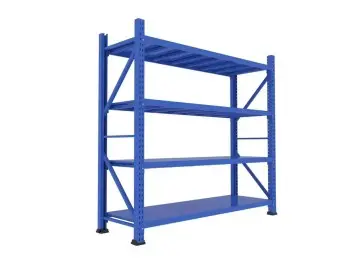
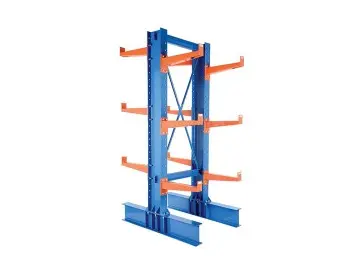
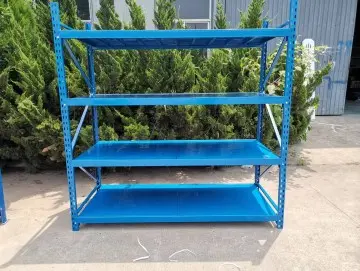
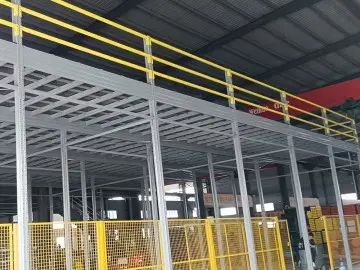
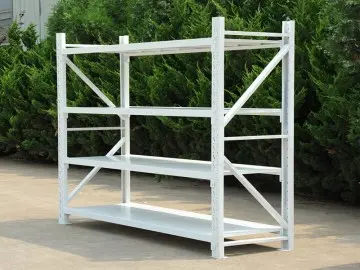
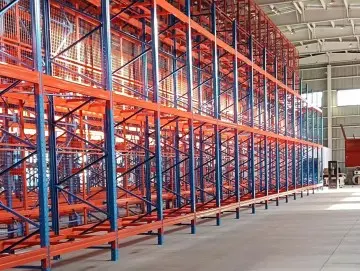
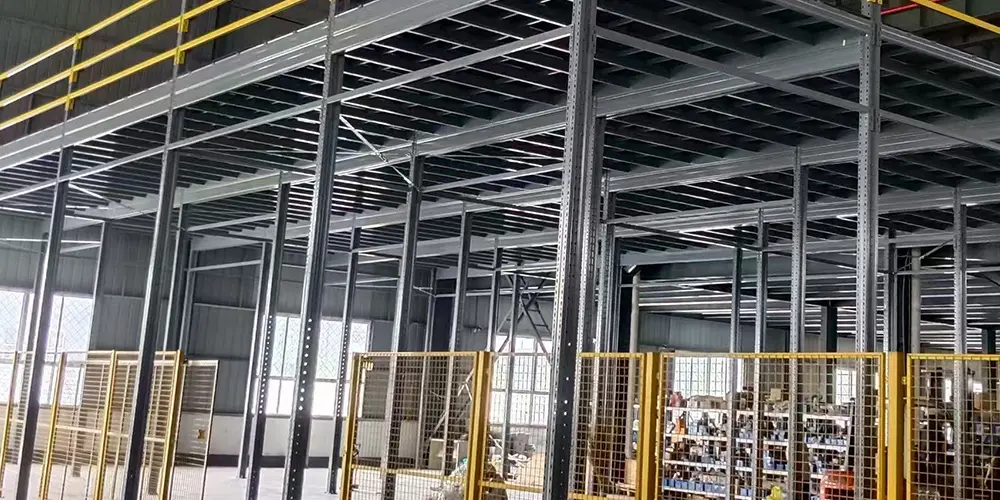
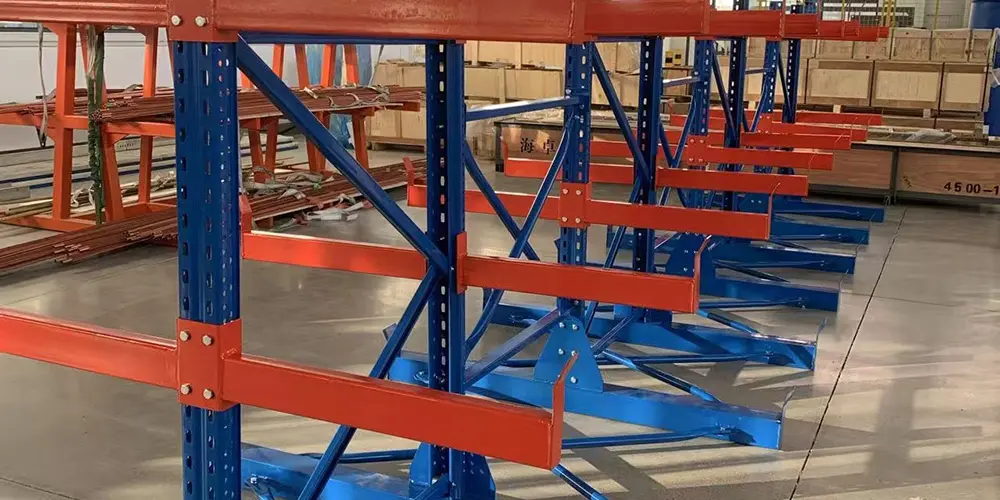
Detailed technical and logistics procurement insights answered directly by our senior structural engineering team.
Cantilever systems eliminate front vertical columns, creating an uninterrupted horizontal shelf span. This structural freedom allows warehouse operators to store non-standard, long-length products (such as steel pipes, extruded aluminum, timber planks, and sheet metal) that cannot fit within the fixed bay width of standard pallet racking systems. Furthermore, stock pickers gain 100% direct linear access without obstruction from aisle-side uprights.
The choice is governed by load weight and operational risk: Choose Roll-Formed C-Channel systems for light to medium duty applications (100kg to 600kg per arm) such as plastic conduits, light tubing, or small wood moldings. Specify Hot-Rolled Structural H-Beams (using Q355B structural steel) for heavy industrial environments requiring load capacities up to 3,500+ kg per arm or where heavy forklifts operated in tight aisles pose higher impact risks.
Arm deflection is calculated using the formula $\delta_{max} = (w \cdot L^4) / (8 \cdot E \cdot I_x)$. International standards (ANSI MH16.2 and FEM 10.2.09) enforce a maximum tip deflection limit of $\mathbf{L / 200}$ under full static load. This prevents permanent plastic deformation and ensures that material placed on arms does not slide forward or cause unintended binding during forklift placement.
All cantilever engineering designs undergo rigorous finite element analysis (FEA) calibrated to regional codes: ANSI MH16.2 / AISC 360-16 for North America, FEM 10.2.09 / EN 15512 with CE certification for Europe, and AS 4084:2023 for Australia. Factory raw materials are supplied with EN 10204 3.1 Mill Test Certificates verifying yield strength and steel chemical composition.
For indoor warehousing, we apply an electrostatic powder coating (60–90 µm thickness) available in customized RAL color codes. For outdoor storage yards, humidity-heavy chemical plants, or coastal locations, we specify Hot-Dip Galvanizing (HDG according to ISO 1461), which coats internal and external steel surfaces with a molten zinc barrier layer providing 30+ years of rust prevention.
Yes. Cantilever systems are frequently paired with Narrow Aisle (VNA) side-loading forklifts using floor-mounted guide rails or inductive wire guidance. Furthermore, advanced facilities integrate cantilever systems with motorized mobile bases to compress aisle footprint, or with automated stacker cranes (Cantilever AS/RS) for unmanned, computerized bar-stock retrieval.
To produce a stamped CAD layout design and quote, our engineering team requires: (1) Warehouse floor dimensions and clear ceiling height, (2) Detailed product profile (length, depth, outer diameter, and unit load weight), (3) Required arm length and vertical arm clearance, (4) Operating forklift model and turning radius, and (5) Environmental factors (indoor vs outdoor, seismic location data).
Standard manufacturing lead time is 15 to 25 days depending on project tonnage. Components are bundled into custom steel-framed export pallets and shrink-wrapped with waterproof protection to enable fast, damage-free container loading and unloading at destination ports worldwide (FOB Qingdao / CIF global ports).