An exhaustive analysis of pitch dynamics, dynamic brake regulation, roller bed friction coefficients, and structural load distributions in high-throughput fulfillment centers.
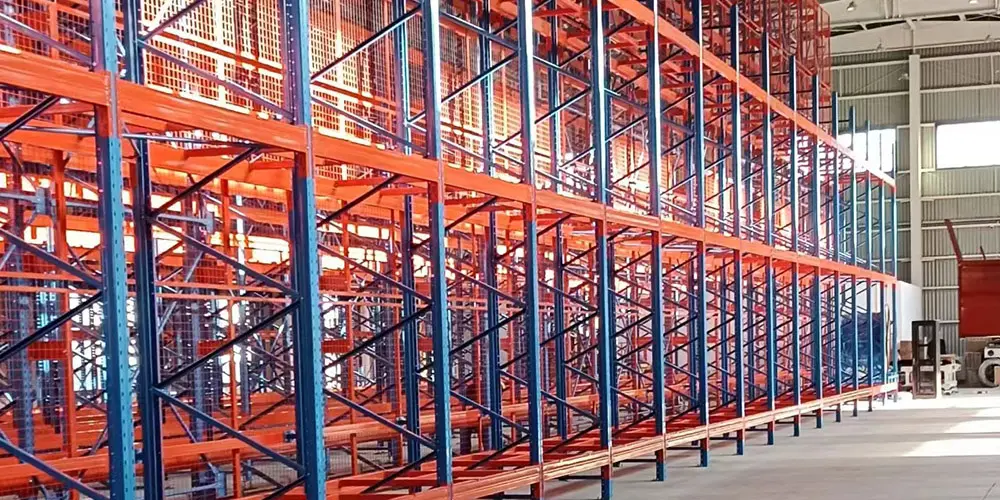
In modern industrial logistics, Gravity Feed Shelving Systems (commonly referred to as live storage racking, carton flow racks, or gravity flow shelving) represent the pinnacle of mechanical efficiency for high-density inventory management. Operating on pure gravitational potential energy, these systems eliminate electrical consumption while enforcing strict First-In, First-Out (FIFO) stock rotation. As a premier China Gravity Feed Shelving System Manufacturer & Factory, Guake Logistics Technology (Shandong) Co., Ltd. engineers engineered flow systems designed to withstand continuous heavy-duty loading while optimizing picking velocity and ergonomic efficiency.
The mechanical core of a gravity feed rack relies on precise incline gradient calculations. Typically calibrated between 2.5° and 4.0° (approx. 4% to 7% slope) depending on container friction coefficients ($\mu$) and unit weight. Precision-engineered pitch angles guarantee seamless sliding without line-pressure damage to sensitive goods.
For deep-lane gravity flow systems holding heavy tote boxes or heavy pallets, control of terminal velocity is vital for safety. Integrated magnetic and centrifugal brake rollers automatically engage when unit speed exceeds 0.3 m/s, absorbing kinetic energy and providing smooth, uniform movement across 30+ meter flow lanes.
A reliable industrial gravity flow shelf consists of engineered structural sub-assemblies calculated via Finite Element Analysis (FEA) to perform reliably under continuous dynamic shock loads:
The minimum operational slope angle ($\theta$) for reliable carton flow is derived from the coefficient of static friction ($\mu_s$) between the carton base and the roller wheel surface: $\theta = \arctan(\mu_s) + \delta$, where $\delta$ represents safety clearance factor (0.5° - 1.0°) accounting for ambient humidity, dust accumulation, and bottom deflection of corrugated boxes.
Evaluating structural density, operational throughput, capital expenditure (CapEx), and inventory flow logic across core warehouse systems.
| Storage System Type | Inventory Flow Logic | Storage Density Gain | Picking Travel Distance | Energy / Automation Requirements | Optimal SKU Profile |
|---|---|---|---|---|---|
| Gravity Feed Shelving | Strict FIFO | +60% to +80% | Reduced by up to 70% | 0 kWh (Pure Gravity) | High-velocity split-case, e-commerce, perishable goods |
| Drive-In Racking | LIFO | +75% to +85% | Moderate (Forklift enters lane) | Manual Forklift operation | Homogeneous bulk goods, seasonal low-SKU count |
| Push-Back Racking | LIFO | +50% to +65% | Low (Aisle-face access) | Mechanical nest cart push | Medium SKU count, 2-6 pallet deep storage |
| Radio Shuttle System | FIFO or LIFO | +80% to +90% | Minimal (Automated shuttle) | Lithium Battery Shuttle Car | Cold storage, high-volume palletized distribution |
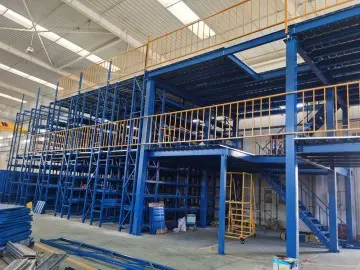
| Steel Platform Mezzanine | Flexible / Multi-Level | +100% Floor Area | Multi-floor localized picking | Stairwells / Freight Elevators | Multi-category, light parts, administrative / picking zones |
How Guake Logistics Technology leverages direct mill steel access, automated roll-forming, and strict metallurgical standards to lower total cost of ownership (TCO).
Located in Shandong, China—the epicenter of high-grade steel manufacturing—our factory sources certified prime Q235B and Q355B structural cold-rolled coil steel directly from top-tier state steel mills. This upstream integration grants us complete control over chemical composition, tensile strength ($\ge 510 \text{ MPa}$), and mill pricing stability.
Our 20,000+ m² facility features automated continuous CNC cold roll-forming production lines capable of punching and profiling upright columns, beam sections, and dynamic gravity roller tracks with micro-level accuracy ($\pm 0.5\text{mm}$ profile tollerance). This guarantees perfect inter-changeability of modular components during site assembly.
Every dynamic frame, beam, and bracket undergoes an automated 7-stage pre-treatment wash followed by thermosetting epoxy-polyester powder coating (60-80 micron coating thickness). Resulting in superior impact resistance, abrasion resistance against rolling wheels, and corrosion resistance exceeding 500 hours of salt spray testing.
Unlike regional suppliers who offer standardized catalog dimensions, Guake operates as a full-spectrum OEM/ODM manufacturer. Whether you require custom roller track pitches for non-standard tote footprints, specialized anti-static ESD roller wheels for electronics assembly lines, or ultra-heavy galvanized pallet flow beds rated for 2,000 kg per position, our in-house R&D team provides complete structural engineering calculations and CAD/3D BIM modeling within 24–48 hours.
Bridging Chinese manufacturing strength with international building codes, seismic engineering standards, and worldwide turn-key project installation services.
Every gravity shelving system manufactured by Guake is engineered in strict compliance with global structural racking codes:
To eliminate international execution risks for enterprise global buyers, Guake offers comprehensive localized engineering support:
Discover how dynamic gravity feed shelving revolutionizes speed, throughput, and accuracy across diverse industry verticals.
Integrated carton flow gravity shelving installed behind conveyor picking lines. Tilted pick trays enable operators to achieve 300+ item picks per hour per aisle, while replenishment stocking occurs continuously from the rear aisle without interrupting picking operations.
Used in temperature-controlled cold rooms (-25°C). Stainless steel roller axles and cold-resistant polymer wheels prevent thermal degradation. Strict FIFO flow guarantees zero product expiration losses for date-sensitive pharmaceutical batches.
Flow channels positioned directly adjacent to automotive assembly workstations. Gravity tracks automatically deliver parts containers to operators in Kanban order, minimizing floor footprint and keeping work areas clear of forklifts.
How smart sensors, IoT integration, and hybrid gravity-shuttle systems are shaping next-generation material handling.
Modern gravity flow lanes are increasingly outfitted with micro-weight sensors and optical break-beam sensors at picking faces. These sensors communicate directly with WMS/ERP systems, triggering automated inventory reorders the instant a lane drops below critical safety stock thresholds.
To minimize picking errors to under 0.01%, gravity flow shelves are integrated with digital Pick-to-Light LED displays mounted on discharge trays. Digital indicators guide workers to the exact lane and item quantity, maximizing picking velocity.
Next-generation gravity discharge beds are designed with custom robotic interface guides. Autonomous Mobile Robots (AMRs) auto-dock with gravity picking trays to accept gravity-transferred totes without human touch, establishing true zero-labor replenishment loops.
Expert responses from our senior warehouse engineering team covering slope design, pallet flow safety, maintenance, and factory customization.
The standard incline gradient for carton flow gravity feed shelving typically ranges between 2.5° and 4.0° (approx. 4% to 7% pitch). For heavy plastic totes with flat bases, a 2.5° slope is often sufficient. For lightweight corrugated cardboard boxes with base deflection, a 3.5° to 4.0° slope ensures smooth movement without stopping mid-lane. During design, Guake conducts physical flow testing with samples of your actual inventory containers to determine the exact optimal pitch.
Gravity feed shelving inherently enforces First-In, First-Out (FIFO) stock rotation because stocking and picking take place in two dedicated separate aisles. Items are loaded from the rear stocking aisle and slide down under gravity to the front picking face. The first item placed into the system is always the first item available for picking, making it ideal for perishable goods, pharmaceuticals, and high-velocity e-commerce SKUs.
Guake manufactures dynamic flow systems spanning multiple duty classes. Light to medium-duty carton flow shelving supports 50 kg to 300 kg per shelf level. Heavy-duty pallet flow racking systems utilize heavy-gauge steel rollers and reinforced structural beams capable of handling up to 2,000 kg per pallet position over flow lanes extending up to 30 meters deep.
In flow lanes exceeding 4 to 5 pallets or deep tote runs, kinetic energy accumulates as items slide. To prevent excessive impact speed at the picking end stop, magnetic or centrifugal brake rollers are installed at calculated intervals along the track. When a pallet or tote passes over a brake roller, the internal centrifugal mechanism creates resistance proportional to speed, maintaining safe movement below 0.3 m/s.
Yes. Guake carton flow tracks are designed with universal mounting brackets that can retrofitted into standard pallet racking frames. By installing modular gravity tracks into the lower level of your existing pallet rack bays, you convert lower levels into high-speed carton pick zones while retaining upper levels for bulk pallet storage overhead.
Our raw materials conform to high-tensile certified steel grades (Q235B / Q355B). Structural designs comply with European EN 15512 and North American ANSI MH16.1 (RMI) standards. All factory manufacturing processes are certified under ISO 9001:2015 quality management protocols with full material test certificate (MTC) traceability.
Because gravity feed systems are purely mechanical and non-powered, maintenance requirements are minimal. We recommend quarterly visual inspections of roller wheels for debris accumulation, checking line divider alignment, and inspecting brake rollers for smooth rotation. Polypropylene wheels with sealed ball bearings require no manual lubrication over their operational lifecycle.
Standard manufacturing lead time is typically 15 to 25 days from drawing approval, depending on total project order volume. We provide full export shipping documentation, flat-pack Knocked-Down (KD) container packing to maximize shipping volume, complete step-by-step 3D assembly guides, and optional dispatch of international site installation supervisors.
Engineered, manufactured, and quality-tested directly in Shandong, China for international distribution networks.
Send your facility CAD drawings, container specs, and throughput targets to receive a engineered layout and factory quotation within 24 hours.