Understanding why modern heavy industrial operations are shifting from conventional floor-stacking to engineered cantilever systems to optimize linear density, structural integrity, and material safety.
In the contemporary industrial logistics ecosystem, handling and storing non-standard, long-format, and high-tonnage materials present unprecedented structural engineering challenges. Material handling engineers, warehouse operational directors, and supply chain managers globally are confronted with escalating floor space costs, stringent workplace safety mandates (such as OSHA and FEM guidelines), and the operational imperative for instantaneous SKU selectivity. Heavy Duty Cantilever Shelving has emerged as the definitive structural storage architecture designed specifically to store items of varying or continuous lengths—such as structural steel H-beams, aluminum extrusions, PVC and copper piping, engineered lumber, raw timber, gypsum panels, and industrial tubing.
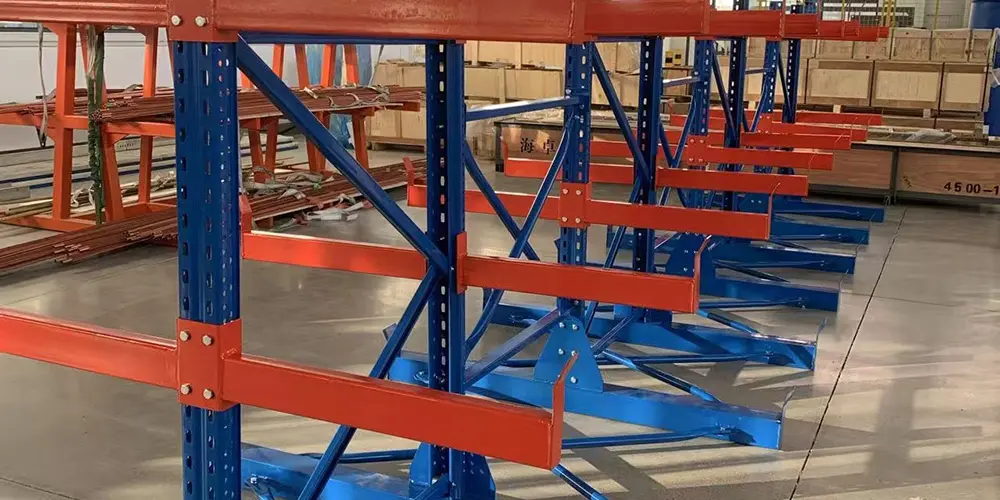
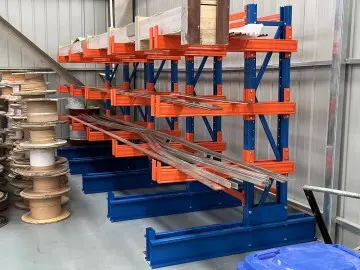
Unlike conventional selective pallet racking—which relies on front vertical upright columns that restrict horizontal loading clearance—cantilever racking utilizes a central vertical column with load-bearing horizontal arms extending outward uninterrupted. This unobstructed front layout enables overhead cranes, side-loaders, and heavy-capacity forklifts to place and retrieve items without structural interference. As global manufacturing transitions toward high-mix, variable-volume production models, the demand for high-capacity, modular cantilever systems engineered in China has surged exponentially across North America, Europe, Australia, and the Middle East.
A detailed look into cold-formed vs hot-rolled structural steel, load distribution math, deflection calculation ratios, and safety lock configurations.
Designing a reliable heavy-duty cantilever system requires rigorous structural mechanics calculations. Unlike pallet racking where loads are evenly distributed across two horizontal parallel beams supported at both ends, a cantilever arm acts as a free-standing overhang beam subject to bending moments, shear forces, and rotational torque at the column connection interface.
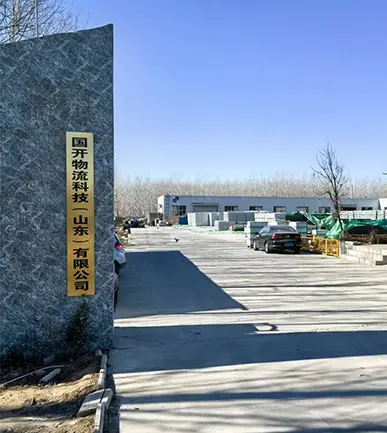
Leading Chinese original equipment manufacturers (OEMs), such as Guake Logistics Technology (Shandong) Co., Ltd. (operating with industrial experience since 2010), utilize finite element analysis (FEA) software to simulate maximum load deflection, seismic response, and torsional resistance. Component sizing adheres strictly to international engineering standards, including RMI (Rack Manufacturers Institute ANSI MH16.3) and FEM 10.2.09 (European Code for Cantilever Racking Design).
| Engineering Parameter | Roll-Formed Light/Medium Cantilever | Structural Hot-Rolled Heavy Cantilever (H-Beam) | Ultra-Heavy Automated Cantilever |
|---|---|---|---|
| Steel Grade Material | Q235B Cold-Rolled Carbon Steel | Q355B / Q355D Structural H-Beam | Q355B / Custom Alloy High-Tensile Steel |
| Column Profile Section | C-Channel / Roll-Formed 200–300mm | Hot-Rolled H-Beam 200–450mm | Heavy Welded Box / Custom H-Beam 500mm+ |
| Arm Load Capacity | 200 kg – 800 kg / arm | 1,000 kg – 4,500 kg / arm | up to 6,000+ kg / arm level |
| Arm Connection Type | Pin-Lock / Light Bolted Plate | Heavy Steel Pin / 4-Bolt Gusset Plate | Precision Machined Hinge / Robot-Welded Flange |
| Deflection Limit Ratio | L / 180 (Standard Industrial) | L / 250 – L / 300 (Strict High-Load) | L / 400 (Automated Crane Precision) |
| Surface Protection | Epoxy Powder Coating (60–80μm) | Electrostatic Powder (80-100μm) / Galvanized | Hot-Dip Galvanized (HDG ISO 1461) |
When loading heavy steel bundles, cantilever arms flex downward slightly under load. To prevent inventory from sliding off, structural engineers apply a subtle upward incline (typically 2° to 4°) during fabrication or implement a tapered arm design. Furthermore, heavy arms are secured using removable steel pipe stops (safety retaining pins) at the front tips. Should a forklift accidentally bump an arm from below, the flexible pin-connection allows the arm to pivot upward without buckling the column structural core, preventing catastrophic structural collapse.
How Shandong’s heavy industrial manufacturing clusters, such as Guake Logistics Technology, integrate automated production lines to deliver superior cost efficiency and global quality compliance.
Located in Shandong Province—China’s primary steel production hub—manufacturers benefit from direct mill supply of high-grade raw structural steel (Q235B, Q355B). This proximity eliminates multi-tier middleman markups, ensuring stable steel pricing and guaranteed metallurgy certificates (MTC ISO 10204) for global buyers.
Modern Chinese racking factories operate CNC laser cutting centers, multi-station automatic cold-roll forming machines, and robotic welding arms. Automated welding eliminates human error in structural gussets, guaranteeing uniform weld penetration and dimensional tolerances within ±0.5mm across all production runs.
Leading manufacturers carry ISO9001, ISO14001, and CE certifications. Ultrasonic weld testing, salt-spray anti-corrosion validation, and hydraulic column compression testing are standard protocol, ensuring long-term load safety under heavy industrial usage cycles.
Furthermore, China’s sophisticated logistics infrastructure allows modular, flat-packed cantilever components to be efficiently bundled into standard 40ft High-Cube containers. Base beams, columns, arms, and bracing frames are packed with heavy-duty protective strapping and custom timber skids, drastically reducing international maritime freight costs per ton of structural storage capacity.
Exploring the transition toward Motorized Mobile Cantilever Systems, Automated Crane Integration (ASRS), and IoT-enabled structural deflection monitoring.
To counteract sky-rocketing land prices, enterprise buyers are increasingly adopting electric mobile cantilever systems. Heavy structural cantilever columns are mounted onto heavy-duty motorized bases that travel along floor-embedded steel rails. By eliminating static forklift aisles and opening a single dynamic working aisle on demand, storage density increases by up to 85% within the exact same building footprint. Integrated safety light curtains and emergency stop sensors ensure full protection for personnel and material handling equipment.
High-throughput manufacturing environments—such as aluminum profile extruders and automated pipe mills—are integrating heavy cantilever structures with Automated Storage and Retrieval Systems (AS/RS). Automated stacker cranes equipped with twin-fork extraction mechanisms travel at high speed along multi-tier cantilever aisles. WMS (Warehouse Management System) software tracks every single bundle length, weight, and batch ID, enabling 24/7 dark warehouse operations without manual forklift intervention.
Industrial lumber yards and naval steel logistics centers require all-weather outdoor storage solutions. Chinese factories are expanding their continuous Hot-Dip Galvanizing (HDG) capacity. By submerging fabricated structural H-beams in molten zinc at 450°C, a zinc-iron alloy coating layer (85–100μm thick) is fused to the steel. This provides over 30+ years of maintenance-free cathodic protection against rust, coastal salt spray, and extreme temperature fluctuations.
The integration of Industry 4.0 IoT sensors directly into critical load-bearing arms represents the frontier of structural storage safety. Micro-strain gauges and optical laser distance sensors wirelessly relay real-time deflection telemetry to warehouse operation control centers. If a forklift operator accidentally overloads a specific arm tier or subjects a column to eccentric loading beyond rated structural thresholds, an automated visual/audible alert is instantly triggered.
How heavy-duty cantilever racks are configured differently across diverse global industrial environments to accommodate distinct load geometry and material handling equipment.
Key Requirement: Storing plywood sheets, MDF boards, timber beams, and drywall panels without sagging.
Key Requirement: Extreme point-load capacity for heavy steel bars, carbon steel pipes, and solid billets.
Key Requirement: Vertical storage of complete vehicle bodyshells and chassis frames in open-air lots.
Key Requirement: Storing light-weight but bulky PVC conduit, corrugated HDPE pipe rolls, and aluminum profiles.
A essential step-by-step technical guide for procurement managers, structural consultants, and 3PL planners issuing RFQs to Chinese cantilever manufacturers.
Before requesting a preliminary CAD rack layout and structural quote from a Chinese factory, buyers must compile the following parameters:
When comparing factory proposals, purchasing directors should evaluate beyond initial FOB product price:
Clear, authoritative technical answers addressing load distribution, seismic compliance, ocean freight packaging, and custom OEM manufacturing.
Single-sided cantilever racks feature columns with arms extending from only one side, designed to sit flush against warehouse perimeter walls to maximize edge floor space. Double-sided cantilever racks feature a central vertical column with load-bearing arms extending outward from both front and back faces. Double-sided configurations offer superior structural equilibrium because opposing loads counterbalance center column bending moments, making them ideal for high-density central storage aisles accessed by forklifts on both sides.
To prevent product deflection (sagging) between arms, the number of support arms depends directly on the flexibility of the material being stored. A standard engineering rule of thumb dictates that the overhang at both ends should equal half of the distance between arm centers (A/2). For example, for a 6-meter steel pipe bundle with arms spaced 2 meters apart, a 3-arm support configuration ensures equal load distribution without permanent sagging or structural over-stressing of individual arms.
Premier manufacturers in Shandong, China—including Guake Logistics Technology (Shandong) Co., Ltd.—design and fabricate cantilever systems adhering strictly to international structural codes:
• ANSI MH16.3 / RMI: Specification for the Design, Testing, and Utilization of Industrial Steel Cantilever Racks (USA).
• FEM 10.2.09: European Code for Cantilever Racks Design.
• AS4084-2012: Australian Standard for Steel Storage Racking.
• ISO 9001:2015: Quality Management System certification governing production, welding inspections, and material traceability.
Yes. For outdoor deployment (such as timber distribution yards, steel pipe staging grounds, or port terminals), racks are treated with Hot-Dip Galvanizing (HDG) per ISO 1461. Components are submerged in liquid zinc after metal fabrication, creating a thick 85–100 micron protective shield inside and outside hollow structural members. Additionally, outdoor cantilever setups are designed with sloped bases, water drainage holes, and heavy wind-load bracing frames to withstand localized storm forces.
Because heavy cantilever columns exert severe overturning moments on baseplates during asymmetric loading, the concrete floor slab acts as the structural counterweight anchor. Typically, systems require a non-cracked concrete floor slab with a minimum thickness of 150mm to 250mm and a compressive strength rating of at least 25 to 30 MPa (3,600+ PSI). Heavy-duty mechanical expansion anchors or chemical epoxy anchor studs (M16x125mm to M24x200mm) are used to fix the wide steel baseplate to the slab.
Guake Logistics Technology provides full lifecycle turnkey support for international clients:
1. Free CAD/3D Layout & Structural Calculation: Buyers submit building floor plans and load profiles; engineers deliver CAD layouts and structural capacity drawings within 24-48 hours.
2. Export Seaworthy Packaging: Columns, arms, and bracing are steel-strapped, protected with bubble wrap film, and loaded onto specialized timber cradles for damage-free container loading.
3. Installation Guidance: Detailed installation manuals, component identification tags, structural bolt torque specs, and remote video technical support are included with every export delivery.