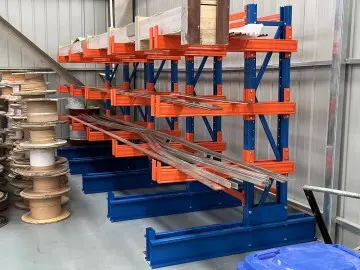
Direct factory production models manufactured to international standards (ISO9001, FEM, AS4084, ANSI/RMI).
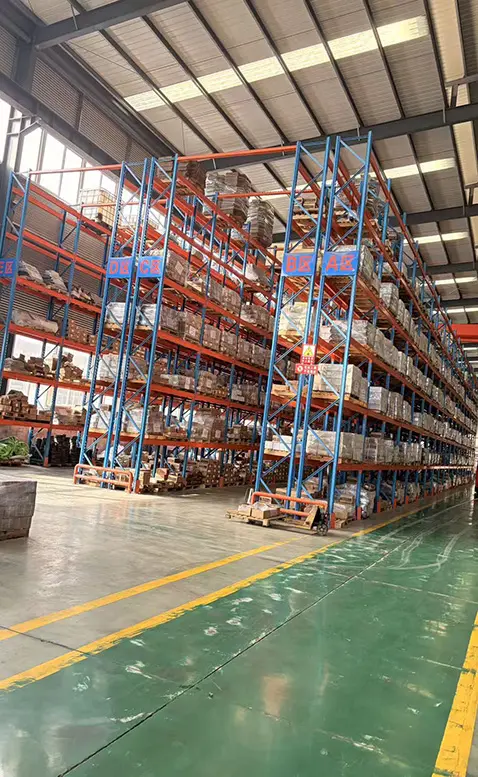
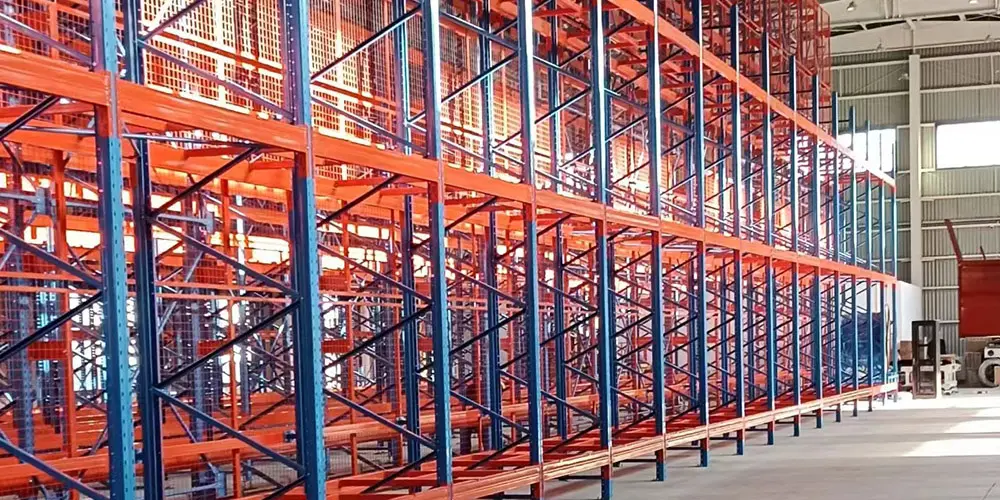
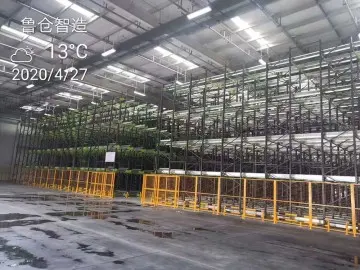
Why modern industrial logistics is abandoning floor-stacking in favor of engineered cantilever arm architectures for non-standard, long-format commodities.
In the evolving landscape of global industrial material handling, the management of non-standard, long-format, and heavy-item inventory presents a unique structural challenge. Traditional pallet racking systems, governed by front upright columns, create insurmountable spatial barriers when storing items such as steel pipes, extruded aluminum profiles, structural timber, PVC conduits, sheet metals, and automotive components. Industrial cantilever shelving has emerged as the definitive engineering response—eliminating front-column obstruction to provide uninterrupted horizontal storage runs.
As commercial real estate costs continue to escalate globally—with industrial warehouse lease rates increasing by an average of 8.2% annually across North American and European logistics hubs—enterprises are forced to maximize volumetric (cubic) floor utilization. Floor-stacking long goods results in severe operational inefficiencies: lost floor space, high product damage rates due to load crushing, poor stock rotation (LIFO bias), and grave workplace safety hazards. Transitioning to engineered heavy-duty cantilever systems enables industrial facilities to expand vertically up to 12 meters, achieving up to an 85% increase in usable storage density while ensuring 100% direct selectivity for every individual item SKU.
Key Strategic Takeaway: According to global warehouse logistics benchmarks, upgrading from floor-stacking long materials to a optimized structural cantilever arm architecture reduces material handling cycle times by up to 45% and decreases inventory damage costs by more than 60% over a 3-year operational window.
A granular breakdown of mechanical forces, material metallurgy, profiles, and structural safety calculations.
Engineered using hot-rolled H-beam structural steel (IPE/HEA sections) or heavy cold-roll-formed C-profiles. Column bases are robotically welded to heavy anchor plates, transferring vertical loads and bending moments directly into concrete foundations via high-tensile chemical anchors.
Arm profiles feature specialized connection plates that lock into column pitch slots at 100mm or 140mm increments. Utilizing heavy-duty pin connections, arms pivot upward if struck by forklifts, preventing dynamic structural shear and column collapse.
Calculated in strict compliance with FEM 10.2.09 standards. Arm loads are calculated based on uniformly distributed loads (UDL) with load center distance $X = L/2$. Deflection ratios are strictly capped at maximum L/200 under full rated loading capacity.
At Guake Logistics Technology (Shandong) Co., Ltd., raw materials undergo rigorous chemical analysis and mechanical yield testing before fabrication. We utilize certified structural grade steels to guarantee structural integrity across varying temperature regimes:
How Guake Logistics Technology leverages local raw material clusters, robotics, and port logistics to deliver unmatched total cost of ownership (TCO).
Sourcing industrial cantilever shelving from top-tier Chinese manufacturers provides significant strategic cost and execution benefits. Situated in Linyi, Shandong Province—a major industrial logistics hub in East China—Guake Logistics Technology operates at the center of the world's most concentrated steel manufacturing ecosystem. This strategic location offers unique operational advantages for international buyers:
Direct partnership with Tier-1 steel conglomerates (such as Baosteel and Shansteel) eliminates intermediate distributor markups. Real-time mill-direct steel coil purchasing ensures material price stability and full structural batch traceability.
Our 20,000 m² modern production facility features multi-station CNC laser cutting centers, continuous cold-roll forming lines, automatic robotic welding stations, and high-speed powder coating lines, yielding over 5,000 metric tons monthly.
Proximity to Qingdao Port and Rizhao Port allows containerized transport directly from factory to ship. Expedited customs clearance and optimized shipping lines enable typical overseas lead times of 15 to 25 days from contract signing.
Furthermore, Chinese factory OEM/ODM engineering capabilities allow fully custom product configurations without high setup fees. Whether your warehouse layout demands single-sided cantilever columns, double-sided high-bay structures, structural roof-supported outdoor cantilever sheds, or integrated guide rail systems for narrow aisle forklifts, Guake delivers precision-engineered solutions adapted to your exact site requirements.
Real-world engineering deployments across key global manufacturing and logistics sectors.
Application: Storage of heavy steel tubes, rebar bundles, structural angles, and solid alloy bars.
Solution: Heavy-duty structural H-beam double-sided cantilever systems rated at 4,000 kg per arm level, fitted with wire mesh decks and end-stoppers to prevent cylindrical roll-off.
Application: Plywood sheets, MDF panels, framing lumber, and drywall boards.
Solution: Extra-wide column spacing cantilever racks with continuous arm decking, ensuring soft timber products do not sag or flex over long span storage cycles.
Application: Storage of automotive body frames, exhaust pipes, driveshafts, and recycled vehicles.
Solution: Multi-tiered heavy cantilever structures equipped with extended forklift guide rails for safe stock placement in high-density auto dismantling yards.
Application: Aluminum extrusions, plastic conduits, and architectural moldings.
Solution: Light and medium-duty roll-formed cantilever shelving integrated with vertical divider arms, separating light profile variants for rapid manual order picking.
Compare load performance, SKU access, and operational efficiency across major industrial storage architectures.
| Storage System Type | Primary Suitable Cargo | Direct SKU Selectivity | Volumetric Density | Max Load per Unit Level | Handling Equipment Required |
|---|---|---|---|---|---|
| Structural Cantilever Racking | Pipes, Lumber, Extrusions, Sheets, Bar Stock | 100% Direct Access | High (Vertical Focus) | 1,000 kg – 5,000 kg / Arm | Side Loaders, Multi-Directional Forklifts |
| Selective Pallet Racking | Standard Unitized Palletized Goods | 100% Direct Access | Moderate | 1,000 kg – 4,000 kg / Level | Standard Counterbalance, Reach Trucks |
| Drive-In Racking | Homogeneous High-Volume Batch Goods | Low (LIFO Flow) | Very High | 1,000 kg – 1,500 kg / Pallet | Standard Counterbalance Forklifts |
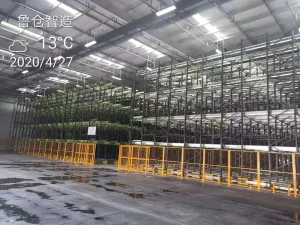
| Radio Shuttle Racking | Cold Storage, FMCG, Dense Pallet Stock | Selectable (FIFO/LIFO) | Maximum Density | 1,500 kg / Pallet Shuttle | Robotic Shuttle + Standard Forklift |
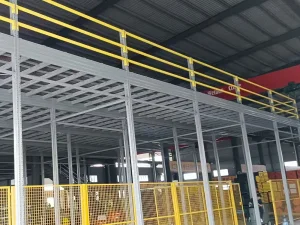
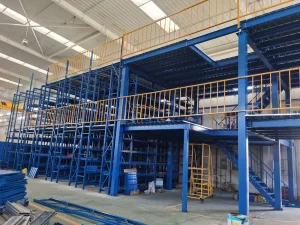
| Steel Structure Platform | Multi-Level Manual Picking, Workstations, Offices | 100% Manual / Cart Access | Floor Area Multiplier | 300 kg – 1,000 kg / m² | Pallet Jacks, Vertical Cargo Lifts |
How Guake maintains strict structural integrity standards from initial CAD engineering through final site commissioning.
Structural reliability in high-capacity storage equipment is a safety-critical priority. Failure of a heavy-duty cantilever arm or main column can result in catastrophic operational risk. Guake Logistics Technology operates under an accredited ISO 9001:2015 Quality Management System, maintaining rigorous process control through every design, cutting, welding, and coating stage.
All cantilever designs undergo Finite Element Analysis (FEA) testing and are certified to meet international racking standard specifications: FEM 10.2.09 (European Code for Cantilever Racks), ANSI MH16.2 (US RMI standard for industrial cantilever racks), and AS4084-2012 (Australian Steel Storage Racking Standard).
For outdoor or high-seismic deployment zones, our engineering team executes customized structural calculations incorporating local seismic ground acceleration values ($S_s$ and $S_1$) and wind uplift forces, adjusting column baseplate size, anchor embedment depth, and rear bracing frames accordingly.
We support overseas engineering teams with comprehensive project documentation packages: certified 3D CAD models, structural load calculation reports, detailed component piece lists, clear step-by-step installation manuals, and live video supervisory support during system setup.
Every installed racking system is backed by a 5-year structural warranty, with ready stock of replacement arms, base protectors, dynamic safety pins, and anchoring hardware available for global dispatch to minimize client downtime.
Integrating automated material handling, IoT structural sensing, and digital twin management into heavy long-goods logistics.
As modern warehousing transitions toward Industry 4.0 automation, cantilever storage is advancing beyond static mechanical steel frames into intelligent, connected logistics nodes. Guake Logistics Technology is actively pioneering next-generation structural developments designed to streamline non-standard material handling:
By pairing high-bay structural cantilever columns with specialized dual-mast stacker cranes and telescopic fork extractors, long bundles up to 12 meters in length can be stored and retrieved automatically without manual forklift intervention. This architecture increases vertical storage heights up to 24 meters and eliminates aisle navigation hazards.
Embedding wireless strain gauges and laser sensors into cantilever arms enables real-time structural health monitoring. The system alerts warehouse safety managers via WMS/WCS dashboards if an arm experiences asymmetrical loading, dynamic impact overload, or permanent structural bending beyond allowable FEM limits.
Integration of embedded RFID tags along individual cantilever arms automatically registers stock placement when tagged pipe or timber bundles are placed by multi-directional reach trucks. This delivers 100% real-time inventory visibility and reduces stock counting cycles from days to seconds.
Clear engineering answers to critical procurement, load calculation, and structural safety inquiries.
Cantilever arm capacity is calculated assuming a Uniformly Distributed Load (UDL) acting over the usable length of the arm. The load center distance ($X$) is defined as half of the total arm length ($L/2$). For example, on a 1,200mm long arm rated for 1,000 kg, the load center is located at 600mm from the column face. Concentrating weight at the outer tip of the arm reduces its rated load capacity by up to 50% due to increased bending moment ($M = F \cdot x$).
Roll-formed cantilever racking is manufactured from cold-rolled steel coils, making it lightweight, modular, and cost-effective for light-to-medium loads (up to 800 kg per arm). Hot-rolled H-beam cantilever racking utilizes structural IPE/HEA steel sections welded to thick base plates. Hot-rolled systems are designed for heavy-duty industrial applications (handling 1,000 kg to over 5,000 kg per arm), providing superior resistance to forklift impact and dynamic overload forces.
Safety pin pivotal arm connections allow the arm to rotate upward if accidentally lifted by a forklift mast or load during picking operations. This upward clearance prevents the rigid transfer of upward shear forces to the main upright column, protecting both the rack structure from catastrophic column damage and the forklift operator from collapsing steelwork.
Column spacing is governed by the length and flexibility of the material being stored. The overhang of the stored product past the end arms should not exceed half of the distance between adjacent arms ($L_o \le S/2$). The material should be supported by enough arms to prevent structural deflection or sagging between supports. Typically, timber sheets require arm spacing every 1.0m to 1.2m, whereas rigid structural steel pipes can span columns spaced 1.5m to 2.5m apart.
Heavy cantilever columns exert concentrated vertical compressive loads and significant dynamic bending moments onto the building floor slab. Most standard industrial installations require a reinforced concrete floor slab with a minimum thickness of 150mm to 250mm and a minimum compressive strength of 25–30 MPa (C25/C30 grade concrete). Heavy-duty high-bay systems may require dedicated reinforced concrete footings designed according to specific column baseplate loading calculations.
Yes. Outdoor cantilever installations require Hot-Dip Galvanized (HDG) surface treatment to ISO 1461 standards, protecting structural steel components against rain, snow, salt, and atmospheric corrosion. Outdoor systems can also be engineered with integrated roof-canopy arms, gutters, and wind-bracing trusses to create cost-effective covered outdoor material storage sheds without erecting full building walls.
Select from our specialized line of storage platforms, automated shuttle systems, and heavy-duty arm racks.