Explore our top-tier industrial storage architectures, engineered for maximum volumetric density, structural safety, and high-throughput intra-logistics efficiency.
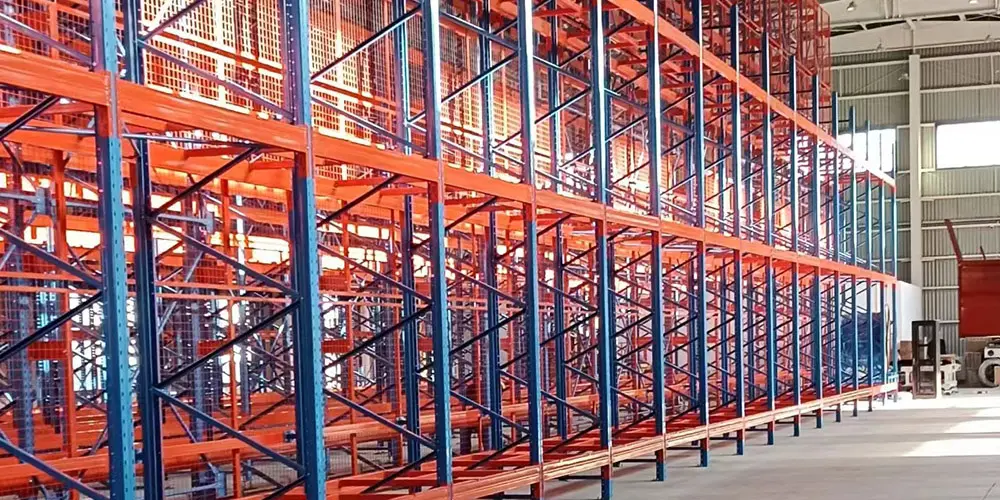
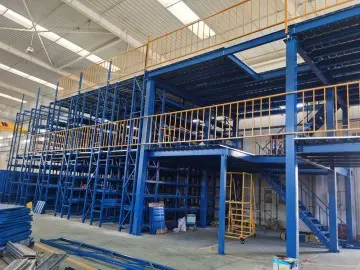
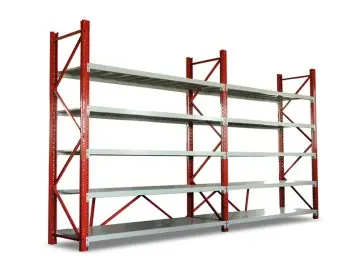
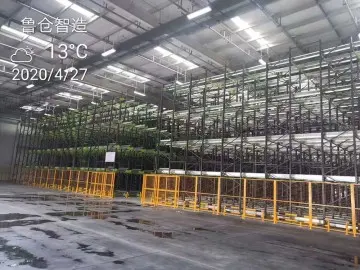
In the contemporary global supply chain landscape, industrial real estate acquisition and lease costs have surged by over 38% across major logistics nodes in North America, Europe, and the Asia-Pacific region. As a direct consequence, logistics enterprise directors, 3PL managers, and plant operations executives are forced to pivot from horizontal warehouse expansion to high-density cubic optimization. Advanced industrial material storage rack systems engineered by leading Chinese manufacturers represent the epicenter of this technological shift.
China's modern industrial storage rack manufacturing sector has evolved from raw structural steel fabrication into a highly sophisticated, engineering-driven ecosystem. Factories located in industrial hubs such as Shandong leverage cold-roll forming, automated robotic welding, and FEA-backed structural simulation to produce load-bearing racking systems that strictly adhere to global standards including FEM 10.2.02, RMI (ANSI MH16.1), and AS4084-2012.
When global buyers evaluate a China industrial material storage racks manufacturer, establishing Experience, Expertise, Authoritativeness, and Trustworthiness (E-E-A-T) requires transparent analysis of metallurgical integrity, engineering validation, and supply chain control. Chinese manufacturers, particularly specialized facilities like Guake Logistics Technology in Shandong, possess distinct structural advantages:
Direct integration with premier domestic steel mills (such as Baosteel and Shougang) ensures certified Q235B and Q355B structural steel coils. Every batch undergoes rigorous yield strength, tensile testing, and chemical composition audit before cold-forming.
High-speed, multi-stage continuous roll-forming production lines ensure upright column profile tolerances are maintained within microscopic thresholds (< 0.5mm deviation over 12 meters), guaranteeing structural alignment during complex field assembly.
Automated pre-treatment cleaning, phosphating, and electrostatic epoxy-polyester powder coating lines create a durable, scratch-resistant finish resistant to humidity, chemical degradation, and abrasion in high-traffic logistics environments.
Selecting the optimal industrial rack architecture requires evaluating structural trade-offs across storage density, selectivity, and handling equipment requirements:
| Storage System Type | Volumetric Density | Pallet Selectivity | Operational Flow | Primary Industrial Application |
|---|---|---|---|---|
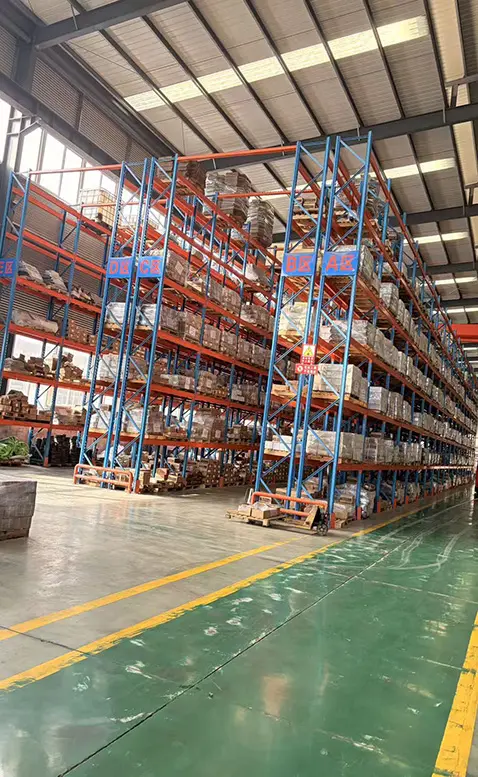
| Selective Beam Racking | Standard (35-45%) | 100% Direct Access | FIFO / LIFO | High SKU diversity, fast-moving consumer goods (FMCG). |
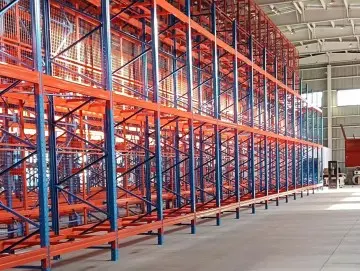
| Radio Shuttle Racking | Ultra-High (80-90%) | Lane-Dependent | FIFO or LIFO | Cold storage, food & beverage, bulk homogeneous inventory. |
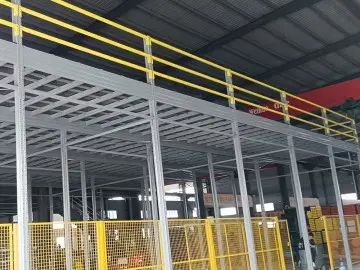
| Multi-Tier Mezzanine Platform | Floor Doubling (+100%) | 100% Manual Access | Continuous Flow | E-commerce order picking, spare parts, archive storage. |
| Push Back Racking | High (60-70%) | Lane-Face Access | Strict LIFO | Medium SKU counts, 2 to 5 deep pallet consolidation. |
| Motorized Mobile Racking | Maximum (85-95%) | 100% (Single Aisle) | FIFO / LIFO | High-value square-foot facilities, deep freeze logistics. |
A engineering breakdown of core storage rack categories produced by Chinese factories illustrates how mechanical design translates to daily operation security and ROI:
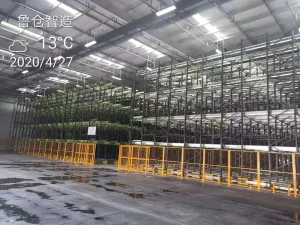
Utilizes semi-automated battery-powered shuttles navigating along internal rack guide rails. Eliminates forklift entry into storage bays, reducing frame damage risks while dramatically expanding storage depth up to 40+ pallets per channel.
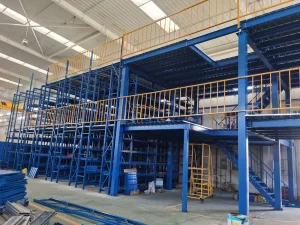
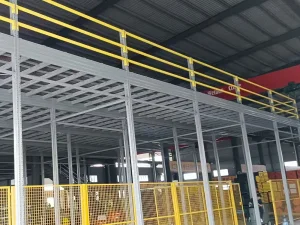
Engineered heavy-duty steel columns, primary I-beams, secondary C/Z purlins, and specialized steel floor decking (checker plate, perforated steel, or mesh) transform vertical space into multi-level operational floors without building modifications.
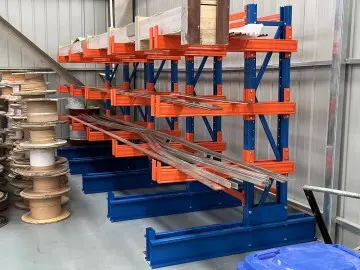
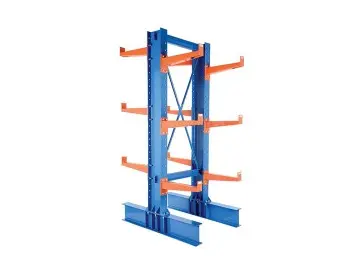
Specifically engineered without front upright columns to store long, bulky, or irregular materials such as steel pipes, timber packs, plastic extrusions, and aluminum profiles. Load arms adjust on 75mm or 100mm pitch patterns.
Industrial storage racks cannot follow a single generic design. Leading Chinese factories customize structural configurations based on localized operational environments, thermal constraints, and material handling workflows:
In cold chain distribution hubs operating at temperatures down to -30°C, volumetric density is essential to minimize energy costs per cubic meter. Shuttle racking and mobile racking equipped with low-temperature synthetic lubricants and specialized high-grade carbon structural steel prevent cold embrittlement and preserve system longevity.
Automotive assembly operations require heavy-duty structural steel platform mezzanines and customized cantilever racks capable of supporting heavy metal stamping dies, engine blocks, and sub-assemblies. Load calculations incorporate dynamic impact factors caused by heavy overhead crane placing and forklift loading.
High-speed e-commerce centers prioritize vertical multi-tier mezzanine shelving platforms integrated with powered belt conveyors and spiral chutes. This allows multi-level simultaneous manual order picking, multiplying floor space and accelerating order turnaround times during peak promotional cycles.
The next decade of industrial storage design moves beyond static steel framing into fully connected, smart intra-logistics ecosystems. Premier Chinese factories are actively driving technical advancements across key domains:
Designing racking lower-level beam clearances, guide rails, and base plates specifically tailored for Autonomous Mobile Robots (AMR) and Automated Guided Vehicles (AGVs), facilitating floor-to-rack pallet placement without human driver intervention.
Integrating embedded strain gauges and wireless impact sensors within critical upright columns. Wireless sensors continuously monitor load deflection and detect accidental forklift collisions, instantly alerting warehouse safety teams.
Adopting low-carbon steel alloys manufactured via electric arc furnaces (EAF) powered by renewable energy, combined with solvent-free zero-VOC powder coating processes to meet global ESG compliance requirements.
Successfully deploying an overseas racking project requires rigorous end-to-end quality control and engineering support. Professional Chinese manufacturers back international buyers through structured project stages:
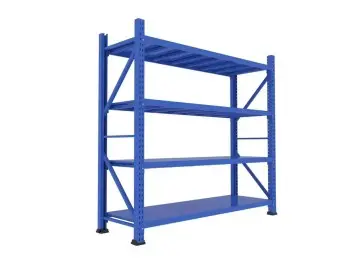
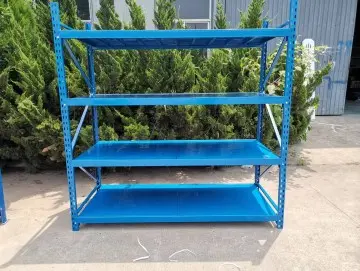
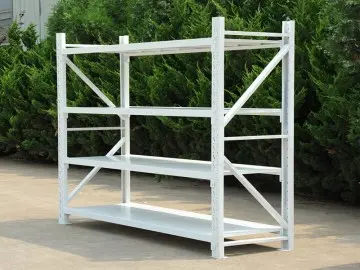
Explore our broader selection of specialized racking systems, light-to-heavy shelving products, and steel platforms available for direct export manufacturing.
Detailed technical answers to common questions asked by international procurement managers, structural engineers, and logistics consultants when sourcing industrial storage racks from China.
Reputable Chinese storage rack manufacturers primarily utilize high-tensile carbon steel grades Q235B and Q355B (equivalent to European S235JR and S355JR, or ASTM A36 and ASTM A572 Grade 50). Q355B steel is specifically chosen for heavy-load upright frames and structural beams due to its superior yield strength (355 MPa), allowing thinner profile walls without sacrificing structural load capacity, thereby reducing shipping weight and costs.
Export-oriented Chinese factories adhere to international design codes including FEM 10.2.02 (European Federation of Materials Handling), RMI ANSI MH16.1 (Rack Manufacturers Institute in the USA), and Australian Standard AS4084-2012. Structural calculations are validated using Finite Element Analysis (FEA) software, and physical load testing is routinely conducted on upright frames, beam connectors, and shelf panels under third-party inspection (such as SGS or TÜV Rheinland).
While both systems maximize volumetric density by eliminating aisles, their operation differs fundamentally. Drive-In Racking requires forklifts to drive inside the racking channels to place or retrieve pallets, increasing rack frame damage risk and operational cycle time. Radio Shuttle Racking utilizes a remote-controlled battery-powered shuttle to transport pallets within the lanes while the forklift remains at the main aisle, resulting in significantly faster handling speeds, higher operator safety, and support for both FIFO and LIFO inventory flows.
Yes. Structural steel platform mezzanines are 100% custom-engineered. Chinese engineering teams design column spacing, beam spans, and floor deck cutouts specifically around your existing building columns, building clear height, electrical conduits, and floor slab load limits. Detailed CAD and 3D BIM models are created to ensure exact fitment prior to factory fabrication.
Typical factory production lead time for standard pallet racking or shuttle racking systems ranges from 15 to 25 calendar days following engineering drawing approval. For complex, multi-tier steel structure platforms or automated AS/RS racking projects, production cycles range from 30 to 45 days. Ocean shipping times vary by destination port (e.g., 14-20 days to US West Coast, 25-35 days to Europe/US East Coast).
Upright columns and beams are bundled using heavy-duty steel strapping, corner protectors, and heavy plastic stretch wrap to protect finished powder coatings. Small hardware components, baseplates, bolts, safety pins, and shuttle accessories are packed in reinforced wooden crates or heavy-duty corrugated cartons strapped onto wooden pallets for secure forklift unloading upon arrival at the destination port.