Factory-direct high-density storage solutions manufactured in Shandong, China—built to FEM 10.2.02 and RMI structural standards.
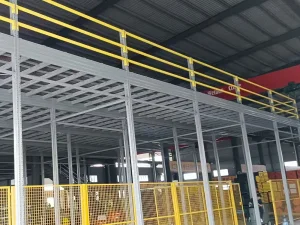
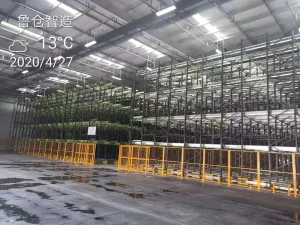
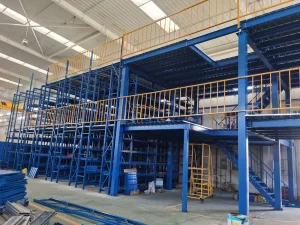
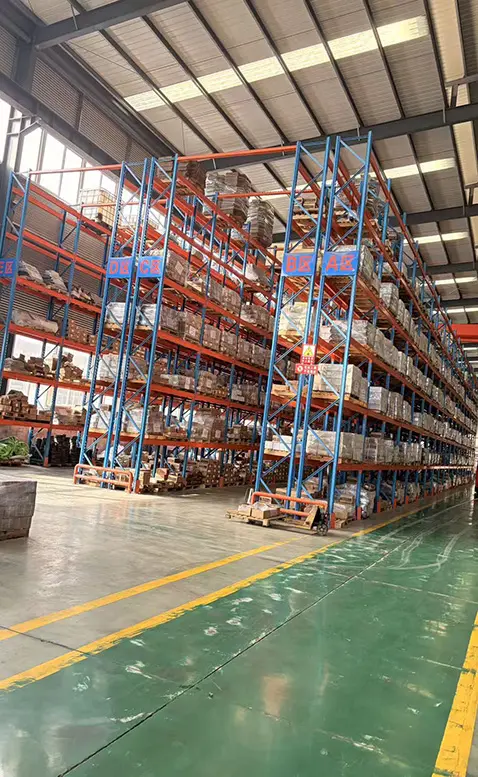
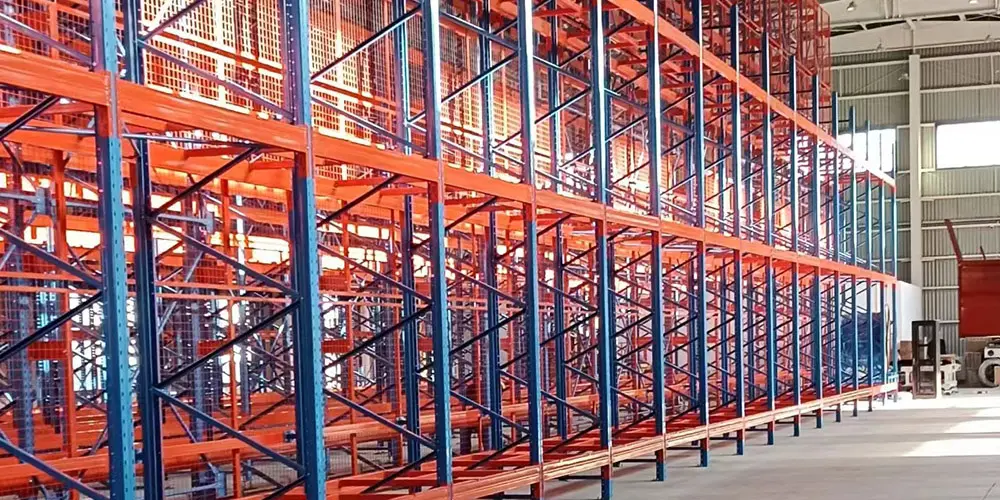
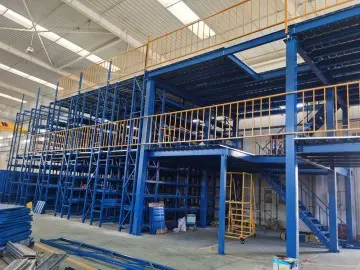
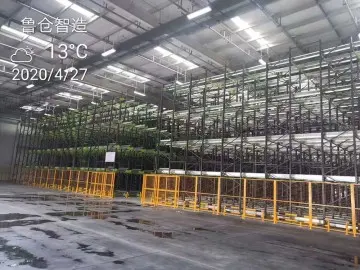
In modern logistics real estate and industrial supply chain management, the "Pallet Position" (PP) is the fundamental economic atom. Evaluating warehouse capital expenditure strictly by floor area (square meters) is an obsolete paradigm; competitive advantage is determined by volumetric efficiency ($/PP/Year).
A standard single Pallet Position is defined structurally as a three-dimensional spatial envelope engineered to securely accommodate a unit load—typically standard EUR (800×1200mm), ISO (1000×1200mm), or North American GMA (48×40 inch) pallets—including vertical clearance safety margins ($S_v \ge 150\text{mm}$) and lateral beam clearances ($S_l \ge 75\text{mm}$).
Chinese OEM/ODM racking manufacturers have redefined global procurement by introducing high-tensile structural steel profiles (Q235B and Q355B cold-rolled steel) that optimize column profile geometry, allowing higher vertical load capacities per linear meter while reducing deadweight.
To calculate the holistic Capital Expenditure (CAPEX) per installed Pallet Position ($C_{pp}$), logistics system architects utilize the following governing equation:
Choosing the optimal racking architecture requires balancing 100% pallet selectivity against spatial volumetric density. China’s leading suppliers provide highly customized variants across the structural spectrum.
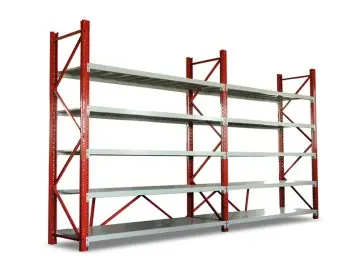
The benchmark for 100% selectivity. Every single pallet position is immediately accessible by standard counterbalanced or reach trucks. Engineered with adjustable beam connectors on 50mm or 75mm pitch profiles.
Semi-automated deep-lane storage utilizing battery-powered self-propelled shuttles. Reduces forklift travel into racks, drastically mitigating structural collision hazards while achieving maximum cubic density.
Heavy-duty selective racks mounted on electronically controlled motorized mobile bases running on embedded floor tracks. Converts multiple fixed aisles into a single operational aisle.
| System Architecture | Storage Density | Pallet Selectivity | CAPEX per PP ($) | Forklift Risk Factor | Operational Flow |
|---|---|---|---|---|---|
| Selective Beam Racking | Baseline (1.0x) | 100% Direct | $25 – $45 | Moderate | FIFO / LIFO |
| Drive-In Racking | High (2.2x) | Low (Lane-level) | $40 – $65 | High (Inside lane travel) | Strict LIFO |
| Push-Back Racking (Cart) | Medium-High (1.7x) | Medium (2-6 Deep) | $60 – $95 | Low | LIFO |
| Radio Shuttle Racking | Ultra-High (2.8x) | High (Batch FIFO/LIFO) | $80 – $130 | Zero (External loading) | FIFO / LIFO Configurable |
| Automated AS/RS (High-Bay) | Maximum (3.5x+) | 100% Automated | $300 – $600+ | Zero (Robotic Stacker Crane) | Software Controlled (WMS/WCS) |
China’s structural steel fabrication infrastructure, centered in key manufacturing hubs like Shandong, delivers unprecedented advantages in steel coil metallurgy, continuous cold roll-forming, surface treatment, and global shipping logistics.
Chinese manufacturers leverage direct raw material procurement from top steel mills (Baosteel, Shougang, Ansteel). By selecting cold-rolled structural steel coils with verified yield strengths ($\sigma_y \ge 355 \text{ MPa}$), vertical upright posts achieve enhanced moment resistance without unnecessary structural mass.
Modern Chinese facilities utilize 18 to 24-stage continuous cold roll-forming machines for seamless upright beam production. Automatic continuous welding robots execute beam-connector joints under shielding gas, eliminating micro-fissures and guaranteeing uniform load distribution across beam connectors.
Surface treatment includes 6-stage chemical pre-treatment (degreasing, phosphating, passivation) followed by automatic electrostatic powder coating (60–80 μm thickness). Coating adhesion complies with ISO 2409 Cross-Cut testing, offering long-term resistance against humidity, abrasion, and chemical exposure.
Pallet position configurations must adapt dynamically to localized operating temperatures, SKU velocities, and regulatory compliance standards across diverse industrial domains.
Cold storage facilities incur massive operational energy expenses ($/m³). Maximizing pallet positions per cubic meter is paramount.
Engineering Strategy: Implementation of Radio Shuttle or Mobile Racking systems using low-temperature impact-resistant steel (Q355E grade) and specialized lubricants for shuttle electronics. Yields up to 85% reduction in wasted refrigerated volume.
High SKU diversity combined with unpredictable order spikes demands high selectivity alongside dense storage.
Engineering Strategy: Hybrid rack architectures integrating lower-tier Pallet Flow/Gravity Racks for fast-moving pick faces with upper-tier Selective Beam Racks for bulk replenishment storage, tightly integrated with WMS inventory routing.
Extreme unit loads reaching 2,500kg to 4,000kg per pallet position, including heavy dies, engines, and steel coils.
Engineering Strategy: Structural channel beam designs ($C$-section profiles) backed by double-entry frame bracing, floor-anchored post protectors, and high-tensile anchor bolts tested for shear displacement under seismic impact.
Strict isolation protocols requiring liquid containment, anti-spark material selection, and fire suppression integration.
Engineering Strategy: Mesh decking with built-in spill containment trays, integrated in-rack sprinkler pipe brackets per NFPA 13 standards, and conductive grounding straps to discharge static electricity.
Industrial racking failure risks massive inventory loss, facility downtime, and human casualty. Sourcing from accredited Chinese manufacturers ensures strict adherence to worldwide structural safety frameworks.
European design code governing static steel racking design. Verifies limit state calculations under combination loading (dead weight, live payload, wind, and placement shock loads).
North American standard for industrial steel storage racks. Mandates rigorous testing for column base plate connection rigidity and frame torsional stability under asymmetric loading.
Australian specification detailing design, testing, and operational parameters for steel storage racking, guaranteeing compliance across APAC logistics infrastructure.
The evolution of industrial storage is shifting from static structural steel to smart, sensor-embedded physical infrastructure integrated into AI-driven supply chain ecosystems.
Deployment of wireless piezoelectric strain sensors embedded inside critical upright columns to alert warehouse operators to structural impacts or overload deflections in real-time.
Seamless interoperability between automated pallet shuttles and floor-level Autonomous Mobile Robots (AMRs) using unified VDA 5050 communication protocols.
Warehouse Management Systems dynamically dynamic re-assign pallet positions using predictive AI algorithms based on seasonal SKU velocity, minimizing crane/shuttle travel distances.
Transition of major Chinese manufacturing plants to hydrogen-reduced green steel, cutting scope 3 embodied carbon per pallet position by over 70%.
Comprehensive answers from our chief structural engineers regarding global procurement, layout planning, and structural safety.
China’s cost competitiveness stems from concentrated supply chain scale economies rather than compromising material quality. Key factors include:
To produce an exact CAD drawing and structural load calculation, engineering teams require:
While all three increase storage density, Radio Shuttle Racking is superior for modern cold chain facilities because it eliminates the structural collision risks of Drive-In racks while providing faster throughput and deeper storage lanes (up to 40+ pallets deep) than mechanical Push-Back cart systems.
Systems are packaged as Knocked-Down (CKD) modular components bundled in protective steel strapping and plastic wrap to maximize 40ft High Cube container loading. Leading Chinese suppliers provide complete structural assembly manuals, 3D erection drawings, video guidance, and can dispatch certified installation supervisors directly to overseas project sites.
For standard indoor operations, electrostatic epoxy powder coating is optimal. For high-humidity, outdoor, or corrosive environments, Hot-Dip Galvanizing (HDG) per ISO 1461 standards is mandatory, applying a protective zinc layer ($>65 \mu\text{m}$) that provides self-healing galvanic protection against oxidation.
Explore our full line of engineered warehousing systems available for global delivery and custom OEM/ODM manufacturing.