
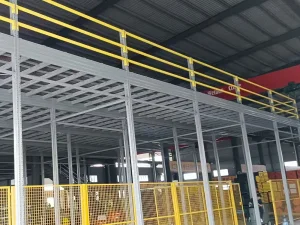


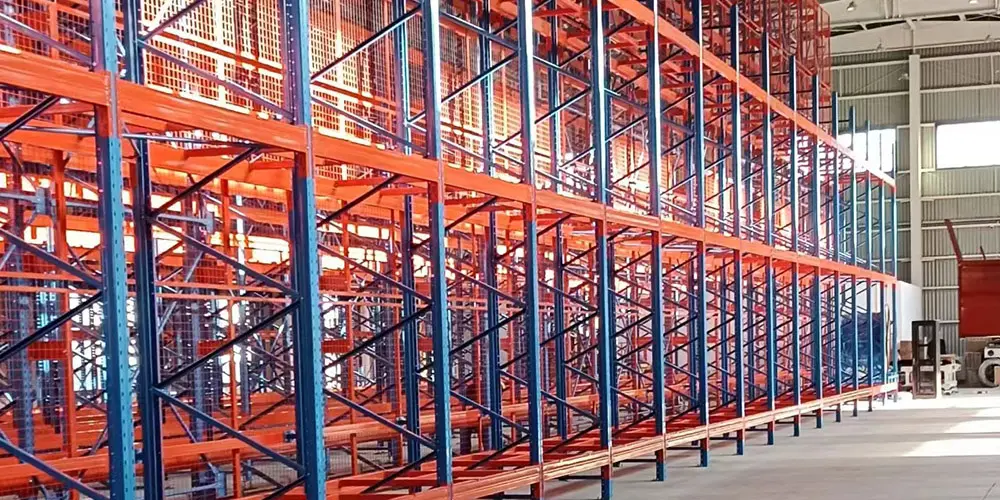
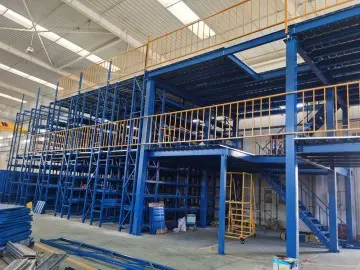
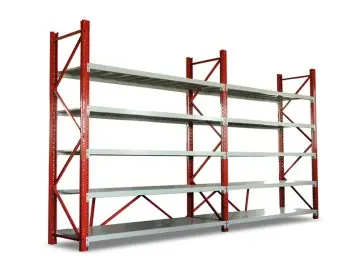
Select from our precision-engineered structural pallet racking portfolio, custom-manufactured to match your specific unit load profiles and space constraints.
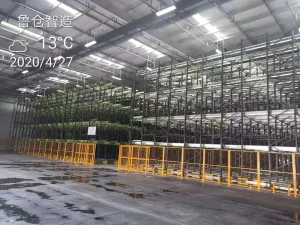
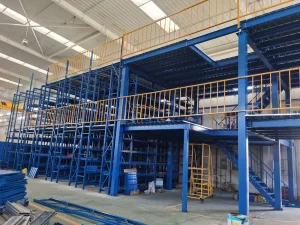
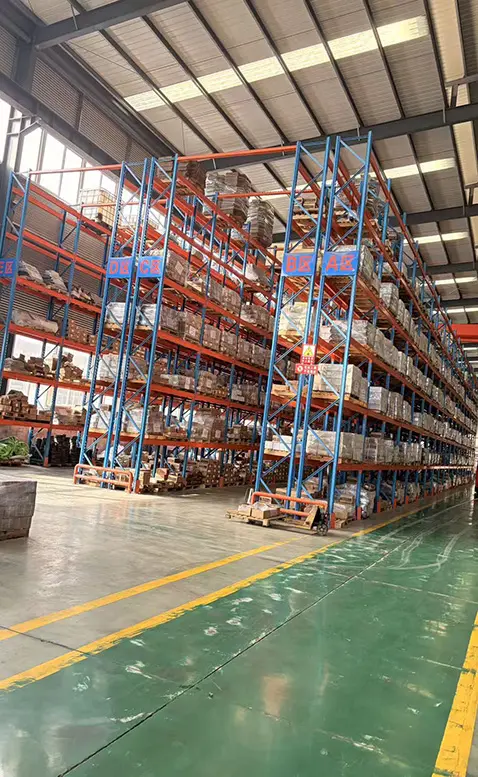
In modern logistics infrastructure, structural safety and load optimization dictate facility profitability and operational resilience.
Global warehouse real estate costs have escalated by over 35% in major logistics hubs. Operators are pushing vertical heights up to 15 meters and pallet loading thresholds to 3,000 kg per level, making structural static and dynamic load verifications paramount.
China's Shandong industrial cluster leads global structural roll-forming technology. Utilizing premium Q235B and Q355B structural steel, manufacturers deliver certified high-yield profiles engineered for aggressive load demands.
Established in 2010 in Linyi, Shandong, Guake Logistics Technology (Shandong) Co., Ltd. operates a 20,000+ m² automated production facility equipped with CNC cold-rolling mills, robotic welding, and automated powder coating lines.
Understanding the physics of beam deflection, column stability, material yield strengths, and safety factors in industrial storage.
Under international standards (such as FEM 10.2.02 and ANSI/RMI MH16.1), the maximum allowed vertical deflection ($\delta$) of a pallet rack beam under design load must not exceed $L/200$ (where $L$ is the clear beam span length). For a 2,700 mm beam level carrying two 1,200 kg pallets, the maximum permissible elastic sag is exactly 13.5 mm. Exceeding this limit causes permanent plastic deformation, beam end connector rotation, and severe risk of dislodging beam locking pins during forklift operations.
Rack load capacities are strictly rated based on a Uniformly Distributed Load (UDL) across two parallel box or step beams. When cargo creates concentrated point loads (e.g., footed containers, heavy machinery die molds, or un-palletized drums), local bending moments spike dramatically. Guake engineers calculate localized flexural stress concentrations and recommend cross-aisle pallet support bars, wire mesh decking, or solid steel decking panels to redistribute load vectors evenly to main load-bearing members.
Vertical frame capacity is governed by column buckling behavior under combined axial compression and bending moments. Guake's cold-formed upright profiles feature optimized 90° omega cross-sections with multiple stiffening ribs. Frame load capacity relies on the unbraced length ($H_{ub}$)—the maximum vertical distance between beam levels. As $H_{ub}$ increases, column stability drops exponentially according to Euler's buckling formula ($P_{cr} = \frac{\pi^2 EI}{(KL)^2}$). Diagonal and horizontal frame bracing must be engineered to withstand lateral shear forces.
The yield strength ($f_y$) of structural steel defines the threshold between elastic recovery and permanent failure. Guake uses prime hot-rolled coil steel processed into Q235B ($f_y \ge 235 \text{ MPa}$, tensile strength $f_u = 375\text{--}500 \text{ MPa}$) for standard applications and Q355B ($f_y \ge 355 \text{ MPa}$) for high-bay and ultra-heavy structural framing. Elevated yield strength permits thinner structural profiles without sacrificing load capacity, optimizing material efficiency and shipping weight.
Tailored structural profiles and heavy-duty designs customized for distinct industrial operating environments worldwide.
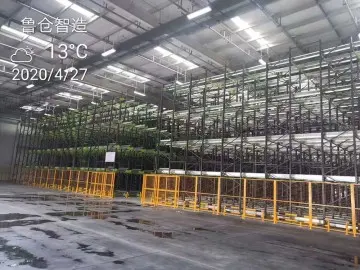
Cold storage facilities incur massive energy costs, demanding maximum cubic density. Guake's Radio Shuttle Racking Systems support lane depths exceeding 30 pallets with continuous 1,500 kg pallet capacities. Steel grades undergo impact toughness testing to prevent brittle failure at sub-zero temperatures.
Automotive stamping plants store metal body dies and engine blocks requiring concentrated point load tolerance up to 3,500 kg per pallet level. Custom heavy beam profiles paired with reinforced safety locking pins prevent dynamic shock load failures during high-frequency reach truck operations.
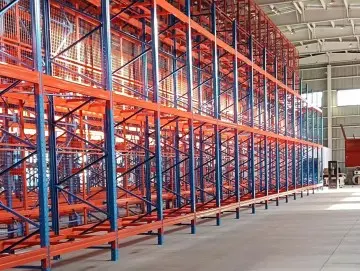
High SKU velocity distribution centers demand 100% direct access selectivity. Selective pallet racking systems engineered with 50mm height adjustment pitches allow rapid reconfiguration of beam levels as inventory dimensions evolve across peak retail seasons.
Comprehensive engineering benchmarks to help warehouse project managers select the optimal racking structure based on load, height, and density requirements.
| Racking Architecture | Max Level Load (UDL) | Max Frame Capacity | Max Storage Height | Selectivity Profile | Structural Compliance |
|---|---|---|---|---|---|
| Selective Pallet Racks | 500 kg – 4,500 kg | up to 24,000 kg | 12.5 Meters | 100% Direct | ANSI MH16.1 / FEM 10.2.02 |
| Drive-In Racking System | 1,000 kg – 1,800 kg | up to 16,000 kg | 11.0 Meters | LIFO Dense | FEM 10.2.07 / ISO 9001 |
| Push-Back Racking | 800 kg – 1,500 kg | up to 18,000 kg | 9.0 Meters | 2-6 Deep LIFO | EN 15512 / RMI Guidelines |
| Radio Shuttle Racking | 500 kg – 2,000 kg | up to 22,000 kg | 16.0 Meters | FIFO / LIFO | CE / FEM 10.2.02 / AS 4084 |
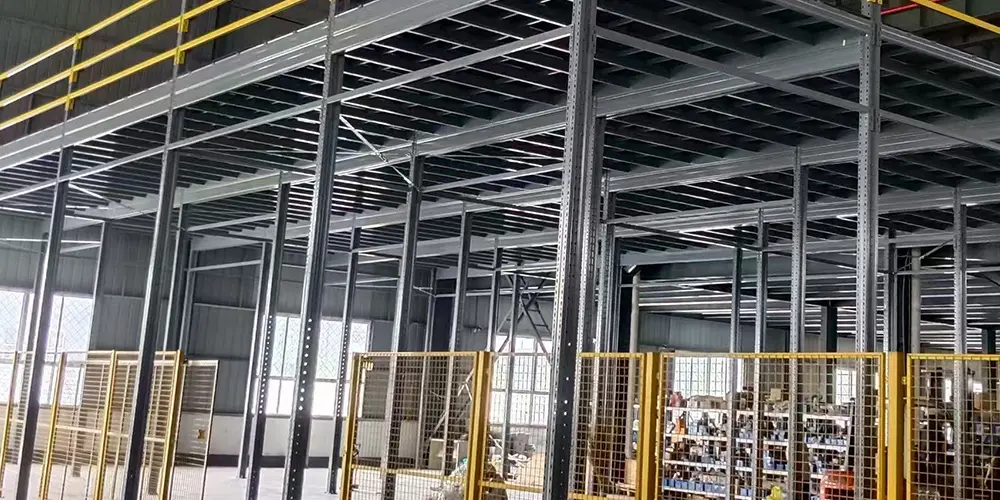
| Steel Structure Platform | 300 kg/m² – 1,500 kg/m² | Custom Structural | 3 Tiers (12m) | Floor Space Expansion | GB 50017-2017 / EN 1993 |
| Motorized Mobile Racking | 1,000 kg – 2,500 kg | up to 30,000 kg | 12.0 Meters | 85% Floor Utilization | FEM 10.2.08 / CE Compliant |
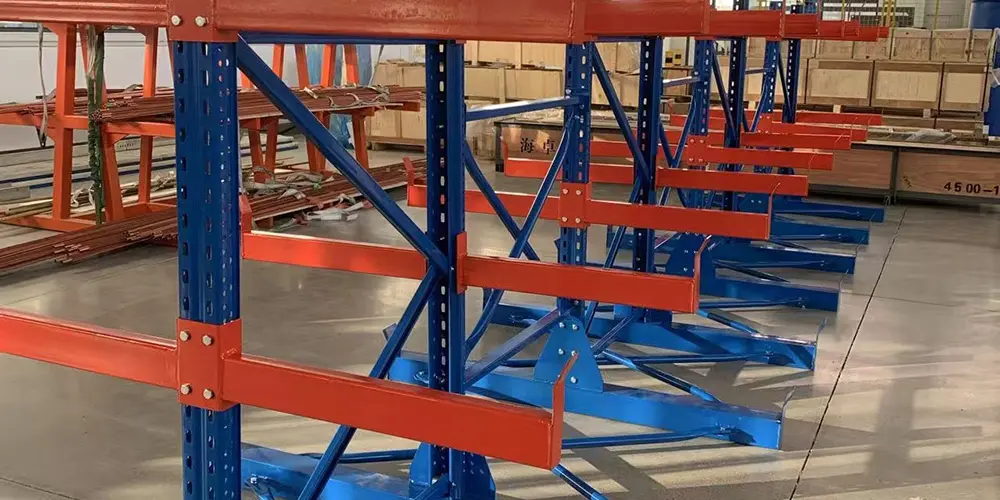
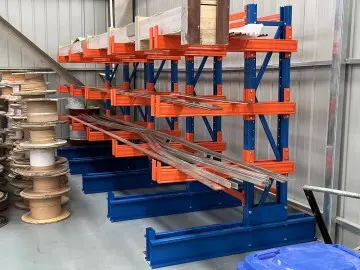
| Cantilever Racking System | 300 kg – 1,800 kg / Arm | up to 15,000 kg | 9.0 Meters | Long Goods Access | ANSI MH16.2 / ISO 9001 |
Exporting heavy industrial storage structures requires rigorous compliance with local building codes, seismic regulations, and structural engineering standards.
All rack designs exported to the United States and Canada adhere to Rack Manufacturers Institute (RMI) standards. Guake conducts finite element analysis (FEA) to verify base plate anchorage, heavy anchor bolt tension/shear loads, and seismic resistance in high PGA (Peak Ground Acceleration) regions like California.
For European logistics projects, structural member sizing conforms to EN 15512 codes. European standards mandate stringent strain gauge testing on cold-formed beam end connectors, beam-to-column stiffness testing ($C_d$), and overall frame imperfection factors ($\Phi_0$).
Compliance with Australian Standard AS 4084 requires explicit verification of rack operational tolerances, beam-locking safety factors (withstanding minimum 150 kg upward dislodgement forces), and dynamic forklift impact resistance calculations on exterior aisle frames.
Integrating IoT sensor technology, digital twin modeling, and advanced metallurgy into high-capacity pallet racking systems.
Future high-bay racking systems feature embedded fiber-optic strain gauges and piezoelectric sensors along critical beam spans. Real-time telemetry detects overload conditions and alerts floor supervisors before structural deformation occurs.
Integrating 3D CAD racking models directly into Warehouse Management Systems (WMS). Real-time telemetry dynamically maps pallet weights onto specific bay coordinates, ensuring optimized structural center-of-gravity distribution across the rack structure.
R&D initiatives focus on cold-rolling micro-alloyed structural steels with yield strengths exceeding 460 MPa. High-yield formulations allow up to 20% reduction in total steel weight while maintaining identical beam load ratings and dynamic safety factors.
Direct engineering answers to the critical load safety, structural sizing, and compliance questions asked by industrial buyers.
Beam load capacity is calculated based on flexural bending moment capacity ($M_y = S_x \cdot f_y$, where $S_x$ is the elastic section modulus and $f_y$ is the yield strength of the steel) and strict vertical deflection criteria. International codes mandate that vertical deflection under maximum uniform load must not exceed $L/200$ (span length divided by 200). Additionally, beam end connector shear capacity and weld shear stress are verified to ensure a minimum structural safety factor of 1.65.
A Uniformly Distributed Load (UDL) assumes the total weight of the pallets is spread evenly across the entire length of both structural cross-beams. A point load (or concentrated load) occurs when cargo weight rests on small contact points—such as container feet or concentrated heavy machinery die molds. Point loading doubles local bending moments. If point loading is required, Guake engineers re-size structural members or add heavy cross-aisle support bars and steel decking panels.
Upright columns act as structural compression members. Frame capacity depends heavily on the vertical distance between beam levels, known as the unbraced length ($H_{ub}$). Larger spacing increases the column slender ratio, dramatically lowering compressive buckling load capacity. Removing a bottom beam level without structural recalculation can reduce overall upright frame load rating by over 40%, creating severe collapse hazards.
Guake adheres to FEM 10.2.02 and ANSI/RMI MH16.1 guidelines, applying a minimum yield safety factor of 1.65 for structural steel components under static working load limit (WLL). For dynamic components, such as shuttle racking rails and mobile rack bases, dynamic impact coefficients ($K = 1.25\text{--}1.50$) are applied to account for forklift placement shocks and vibration acceleration.
At sub-zero temperatures (down to -30°C in food freezing facilities), carbon steel undergoes a ductile-to-brittle transition, increasing susceptibility to sudden impact cracking. Guake utilizes certified killed steel grades with controlled silicon and aluminum content, paired with specialized low-temperature powder coatings and hot-dip galvanizing to ensure long-term structural ductility and impact resistance.
Yes. Every overseas project engineered by Guake Logistics Technology includes complete CAD layout assembly drawings, 3D structural elevation profiles, slab floor load distribution calculations, and official Mill Test Reports (MTR) confirming steel yield strength. These documents satisfy local municipal building permit requirements across North America, Europe, and Australia.
Increasing level capacity requires replacing light-gauge box beams with heavier structural step/box profiles or deeper section depths, plus verifying that total frame capacity and concrete floor slab point loads remain within safety limits. Guake offers complete engineering audits and replacement beam levels compatible with major international upright connection pitch patterns.
Explore our specialized heavy-duty racking systems engineered for high load capacities and maximum spatial efficiency.
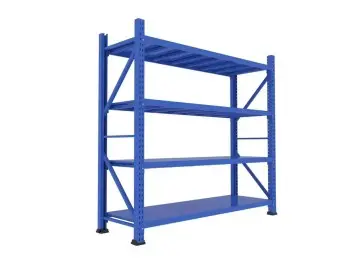
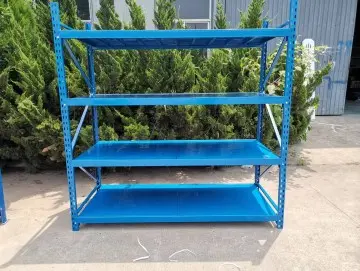
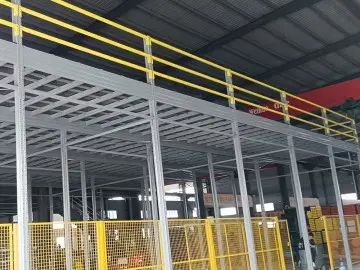
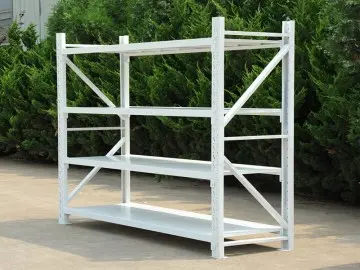
Send your CAD warehouse drawings, clear building height, and pallet load specifications directly to Guake's senior structural engineering team.