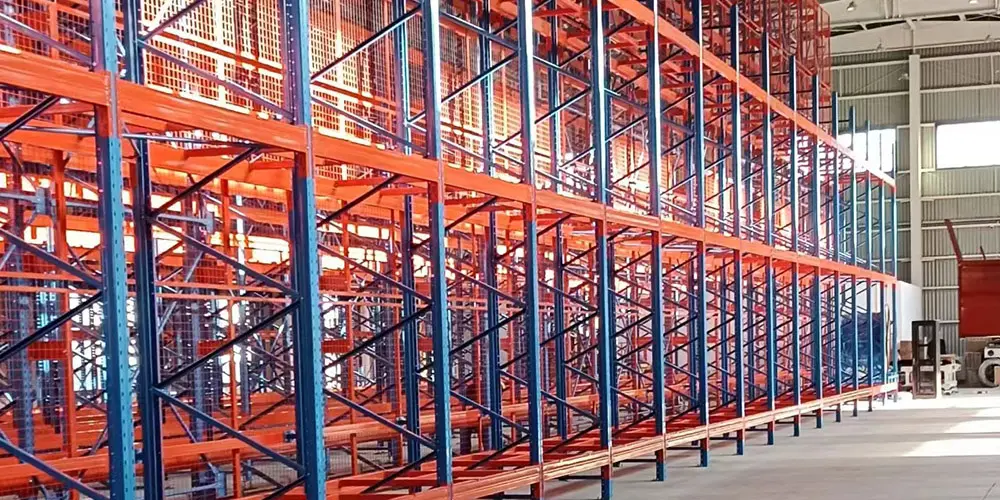
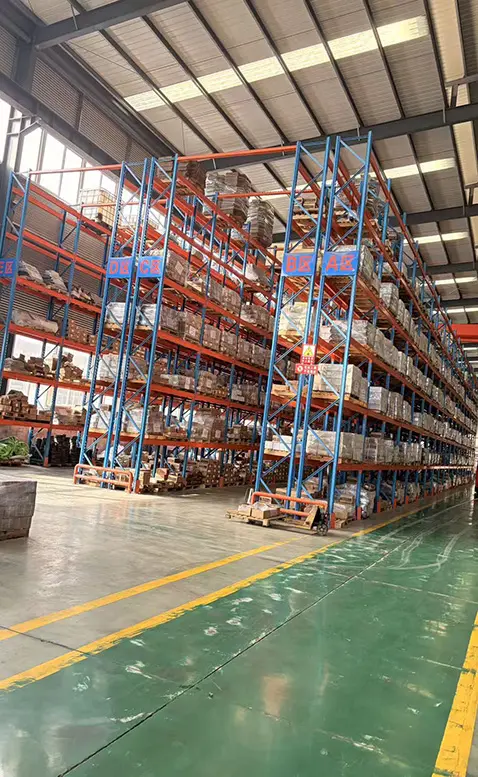
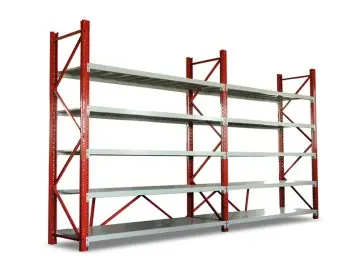
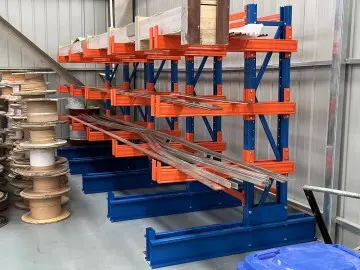
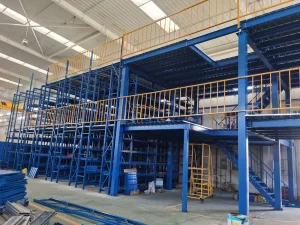
In the global pursuit of warehouse volumetric optimization, **Push Back Shelving and Racking Systems** represent a critical bridge between standard selective racking and fully automated storage. Designed for Last-In, First-Out (LIFO) inventory management, push back systems utilize inclined rails and nested dynamic carts to store pallets 2 to 6 deep per lane face.
Unlike traditional drive-in racking—which requires forklifts to enter structural bays, increasing collision risks and slowing cycle times—push back racking maintains forklift travel strictly within main access aisles. Forklifts load each pallet by pushing existing pallets backward up a slight incline (typically 1.5° to 3° gradient). During retrieval, gravity smoothly feeds subsequent pallets forward to the picking face.
A deep dive into how Guake's nested push back carts operate, preventing jam-ups, handling off-center pallet loads, and ensuring ultra-smooth kinetic rollbacks.
Guake push back shelving systems rely on stacked steel carts riding on inclined structural steel rails. For a 4-deep lane, 3 nested carts rest inside one another at the front. The first pallet rests on the top cart, the second pushes the top cart back to reveal the second cart, and the final pallet rests directly on the fixed structural rails. Low-profile stack height maximizes vertical clear space.
Dynamic loads placed by forklifts can induce horizontal twisting or point-load shock. Our factory integrates flange-guided steel wheels equipped with under-rail anti-lift tabs. Even if a forklift operator impacts the front cart at an angle, the nested assembly remains firmly locked to the incline track, eliminating derailment risks entirely.
The roll-back speed of standard pallets must be tightly controlled to prevent impact damage. Guake calculates precise incline pitch based on client pallet weights (ranging from 300kg to 1500kg). For high-mass applications, integrated magnetic or centrifugal friction brake rollers are positioned along the track to regulate gravity acceleration to under 0.3 m/s.
Selecting the correct warehouse racking architecture requires balancing storage footprint, equipment capital expenditure (CapEx), labor speed, and SKU accessibility. The table below illustrates where **China Push Back Shelving** outperforms competing systems.
| Racking Technology | Storage Density | SKU Selectivity | Forklift Risk | Handling Speed | Target Inventory Type |
|---|---|---|---|---|---|
| Push Back Racking (Guake) | Very High (75%) | 1 SKU per lane (Medium) | Very Low (Stays in aisle) | Fast | Medium SKU count, high batch turnover |
| Drive-In Racking | Maximum (85%) | 1 SKU per bay (Low) | High (Forklift drives inside) | Slow | Low SKU count, massive homogenous stock |
| Radio Shuttle Racking | Maximum (90%) | 1 SKU per channel | Zero (Automated shuttle) | Very Fast | Cold storage, mega distribution centers |
| Selective Pallet Racks | Standard (40%) | 100% Direct Access | Low | Fast | High SKU variety, low quantity per SKU |
| Motorized Mobile Racks | Very High (85%) | 100% (Moving aisles) | Low | Moderate | Cold storage with full item access needs |
How global enterprises integrate Guake China Push Back Shelving to streamline cold supply chains, beverage distribution, automotive buffer zones, and pharmaceutical storage.
Cold storage operating costs per cubic meter are up to 5 times higher than ambient facilities. Push back shelving eliminates unnecessary aisles while avoiding the sensitive electronic maintenance required by fully automated AS/RS in sub-zero climates. Guake uses low-temperature resilient steel grades (such as Q355D) and synthetic synthetic bearing lubricants rated for extreme refrigeration, ensuring zero mechanical binding.
FMCG operations handle high-volume turnover of rotational SKUs. Push back systems enable rapid staging at dock loading doors. Bottlers and food processors place 3-deep or 4-deep push back lines adjacent to shipping lanes, allowing drivers to staging full trailer loads rapidly without blocking main thoroughfares.
Automotive assembly plants require raw material components and stamping parts to be delivered just-in-sequence (JIS). Guake designs custom heavy-duty push back carts equipped with wire mesh decks or custom steel frames designed for automotive metal stillages, allowing lean inventory replenishment directly adjacent to production cells.
In pharmaceutical warehousing, batch containment and floor clear-height compliance are strict necessities. Push back shelving allows pharmaceutical distributors to maintain strict lane-by-lane batch isolation while utilizing vertical height to the maximum extent permitted by ceiling sprinkler clearances.
Located in Linyi, Shandong—China's premier structural steel manufacturing hub—Guake Logistics Technology operates advanced continuous CNC cold roll-forming lines, robotic laser welding stations, and fully automated electrostatic powder coating lines.
All upright profiles, load beams, and cart rails are rolled exclusively from prime steel coils supplied by Baosteel and Shougang Steel. Every batch comes with full 3.1 Mill Test Certificates verifying tensile yield strength exceeding 355 MPa.
Critical load-bearing cart frames undergo 100% robotic MIG welding. Eliminating human variance guarantees perfectly squared cart geometries essential for smooth linear travel inside long push back lanes.
Components pass through an 8-stage pre-treatment wash including zinc-phosphating before receiving an epoxy-polyester powder coat baked at 200°C. Total film thickness exceeds 80 microns, delivering scratch-resistant, anti-corrosive finishes built for decades of industrial wear.
Guake's structural engineering team models every rack installation using Finite Element Analysis (FEA) software. We simulate complex dynamic loading, floor slab deflection, seismic shear forces, and frame buckling limits based on EN 15512 and RMI standards.
Full compliance with international pallet racking codes for structural integrity and seismic safety.
From initial CAD layout drafting to container stuffing, ocean freight, site installation, and lifetime safety inspections, Guake delivers total project peace of mind.
Submit your architectural warehouse layout, building height clearance, and pallet specifications. Within 48 hours, our engineering office returns full 2D layout drawings and 3D structural BIM models detailing exact pallet position counts and forklift aisle dimensions.
Upright frames and beams are bundled with protective steel strapping and heavy foam padding. Cart assemblies arrive pre-nested or modularly pre-assembled to reduce site installation time by up to 50%, optimized specifically for 40ft High Cube sea containers.
Guake provides complete installation manuals, step-by-step assembly drawings, and video tutorials. For large-scale projects across North America, Europe, Southeast Asia, or the Middle East, we dispatch senior commissioning engineers to direct local installation crews.
As modern warehouses transition toward Warehouse Management System (WMS) digitization, Guake is pioneering cart-level position sensors. Wireless micro-switches embedded into the incline tracks report real-time lane occupancy directly to your WMS, alerting operators instantly to open pallet positions without manual scanning.
The next frontier in high-density storage combines autonomous AGV reach trucks with precision-guided push back entry faces. Guake's latest cart alignment tolerances (+/- 2mm) allow robotic forklifts to execute push-and-store cycles autonomously, combining labor-free automation with low mechanical complexity.
Comprehensive structural and operational answers to aid your engineering verification and vendor assessment.
Push back racking is significantly faster (up to 35-40% higher throughput) because forklift operators never enter the rack structure. In drive-in racking, drivers must carefully navigate deep inside narrow aisles, which increases cycle time and drastically heightens upright column impact risks. With push back racking, all loading and unloading occurs at the front aisle face, protecting internal structural members from forklift damage.
Guake manufactures push back racking systems engineered from 2-deep up to 6-deep per lane. A 6-deep system allows up to 12 pallets stored back-to-back in a double-entry rack bay. However, 2-deep to 4-deep designs represent the optimal sweet spot for standard forklift pushing capacities.
Thanks to our low-friction precision sealed steel bearings and calibrated 1.5° to 2° rail inclines, the required push force is minimal—typically only 3% to 5% of the total accumulated pallet weight. Standard warehouse forklifts (electric or internal combustion) can effortlessly store and push full-capacity unit loads without specialized attachments.
Yes. Unlike pallet flow racking (which relies on rollers directly contacting bottom pallet boards), push back systems support the pallet on heavy-gauge steel nested carts. The cart forms a solid perimeter frame under the pallet. Even if a wooden bottom board is broken or cracked, the pallet sits safely on the cart frame without hanging up or jamming the system.
Guake push back systems require virtually zero routine maintenance. The heavy-duty steel wheels utilize permanently sealed, factory-lubricated ball bearings. Maintenance is generally limited to quarterly visual checks of front safety stops, floor anchor torque, and ensuring the inclined tracks remain free of trash or plastic wrapping debris.
Guake engineers calculate seismic shear forces according to local building codes (e.g., Eurocode 8, ASCE 7, or IBC). Anchoring requires high-shear expansion bolts or chemical anchors embedded into reinforced concrete slabs (minimum 150mm to 200mm thickness, C25/30 grade concrete). Floor levelness must conform to DIN 18202 or FM2 superflat standards.
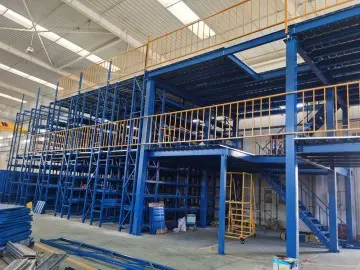
Absolutely. Guake racking components utilize standardized pitch punchings (75mm or 76.2mm). If your product mix shifts in the future, the nested cart rails can be disassembled, allowing the structural upright frames and beams to be reconfigured into standard selective racking, drive-in racking, or integrated mezzanine platforms.
Factory production typically requires 15 to 25 days following engineering drawing approval. Ocean freight times range from 12 days to North American West Coast, 25-30 days to Europe, and 10-15 days to Australia or Southeast Asia. Express production runs are available for urgent facility expansions.
Partner directly with Shandong Guake Logistics Technology. Our senior engineering team will evaluate your CAD floor plan, calculate structural static/dynamic loads, and design a customized Push Back Shelving proposal tailored to your operational goals.