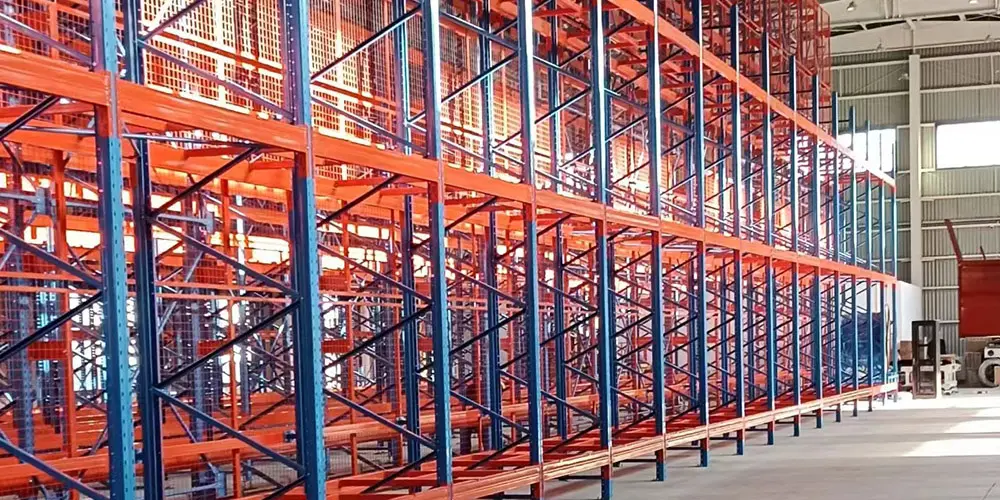
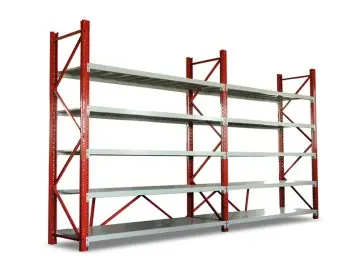
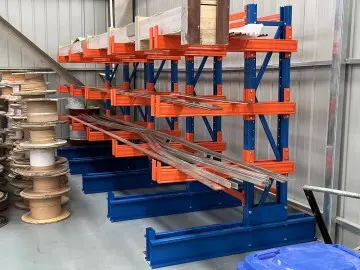
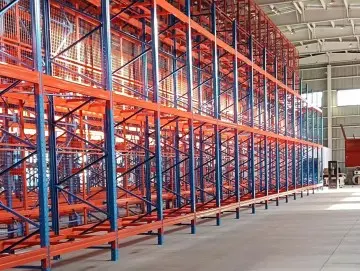
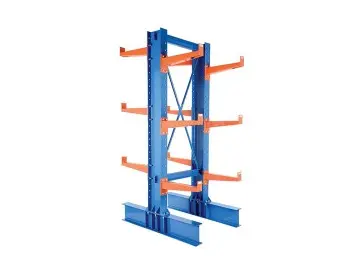
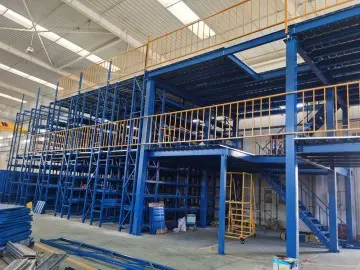
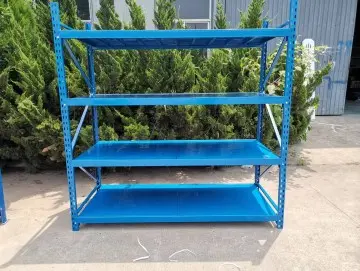
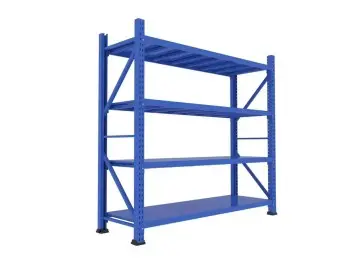
Direct factory-manufactured structural racking systems designed for intense industrial usage, cold chain storage, and high-density warehouse environments.
An engineering analysis of cold-formed carbon steel profiles, load distribution dynamics, and modular post pallet architecture for modern enterprise logistics.
The operational integrity of heavy-duty steel stacking racks (frequently referred to in international procurement specifications as post pallets, stacking stillages, or nestable racking frames) relies directly on structural metallurgy. As a leading manufacturer based in Shandong, China—specifically inside the industrial manufacturing corridor of Linyi—Guake Logistics Technology (Shandong) Co., Ltd. utilizes high-grade Q235B and Q355B structural carbon steel conforming to GB/T 700-2006 and EN 10025 standards.
Compared to standard commercial steel tubing, cold-formed structural square tubing ($60 \times 60\text{ mm}$ to $100 \times 100\text{ mm}$ with wall thicknesses spanning $2.0\text{ mm}$ to $4.5\text{ mm}$) exhibits superior yield strength ($f_y \ge 355\text{ MPa}$) and ultimate tensile strength ($f_u \ge 510\text{ MPa}$). This structural profile ensures that multi-tier stacked load columns resist axial compression and buckling modes under static loads up to 3,000 kg per rack unit.
The structural reliability of steel stacking racks depends on structural joints where vertical post sockets interface with the heavy-duty base chassis. Guake Logistics Technology employs automated multi-axis robotic Metal Inert Gas (MIG) welding systems complying with AWS D1.1/D1.1M structural welding standards and EN ISO 15614 specification rules.
How dynamic warehousing demands, automated handling equipment, and sustainability regulations are reshaping the design of portable stacking frames worldwide.
Traditional selective pallet racking installs permanent steel uprights anchored into concrete floor slabs, locking warehouses into fixed aisle layouts. Global logistics operators are rapidly adopting portable steel stacking racks to establish dynamic flex-space warehousing. When seasonal inventory spikes occur, post pallets are deployed instantly to convert open floor space into high-density storage modules. During off-peak periods, racks are nested or dismounted, freeing floor space for staging, assembly, or cross-docking operations.
Reverse logistics costs represent a major expenditure in modern supply chains. Modern Chinese stacking rack manufacturers are pioneering nestable "8-frame" bases and collapsible post mechanisms that yield space reduction ratios of 1:4 to 1:7 during empty return freight. By maximizing truck trailer cube utilization during return legs, global enterprises reduce scope 3 carbon emissions while lowering freight transport expenditure per unit by up to 68%.
Energy costs in refrigerated and deep-freeze facilities (operating from $-18^\circ\text{C}$ to $-35^\circ\text{C}$) demand maximum volumetric efficiency. Cold-formed steel stacking racks equipped with ISO 1461 compliant Hot-Dip Galvanizing (HDG) prevent micro-cracking and zinc embrittlement caused by rapid thermal cycling. The galvanized layer ($>70\mu\text{m}$ thickness) resists ambient moisture condensation, offering 25+ years of maintenance-free service life in cold-chain logistics hubs.
Quantitative decision matrix evaluating Steel Stacking Racks against fixed racking installations and floor stacking methods for industrial logistics buyers.
| Storage System Type | Cubic Volumetric Efficiency | Initial CapEx per Pallet Position | Floor Slab Anchoring Required | Empty Freight Return Savings | Layout Flexibility Score |
|---|---|---|---|---|---|
| Steel Stacking Racks (Post Pallets) | Very High (85% - 92%) | Low - Medium ($45 - $85) | No (Portable System) | High (Collapsible 1:5 Ratio) | 10/10 (Dynamic Flex) |
| Fixed Selective Pallet Racks | Moderate (40% - 55%) | Medium ($60 - $110) | Yes (Heavy Epoxy Anchor Bolts) | None (Permanent Structure) | 2/10 (Fixed Column Spacing) |
| Drive-In Racking Systems | High (75% - 85%) | High ($100 - $160) | Yes (Guide Rails & Anchor Bolts) | None (Permanent Structure) | 3/10 (LIFO Dedicated Lanes) |
| Unassisted Floor Stacking | Low (25% - 40%) | Zero Initial CapEx | No | Not Applicable | 5/10 (Crushing Hazard Limits) |
For high-volume distribution centers operating in North America, Europe, the Middle East, and Southeast Asia, warehouse space costs per square meter represent a recurring operational expenditure. By stacking post pallets 4 to 5 levels high safely, facilities instantly multiply usable cubic capacity without extending the physical footprint or leasing auxiliary warehouse facilities.
Furthermore, steel stacking racks prevent product crushing damage associated with direct floor stacking of heavy bulk items like automotive tires, rolled textiles, or liquid totes. A typical 3PL facility replacing direct floor stacks with Guake steel stacking frames reports an average 85% decrease in cargo damage claims, achieving complete capital investment payback within 11 to 14 months of operational deployment.
Overseas procurement teams evaluating Chinese manufacturers demand standardized quality control to ensure long-distance shipping resilience. Guake Logistics Technology implements rigorous supply chain quality protocols:
How specialized steel post pallets and nesting stillage structures solve unique material handling challenges across core global manufacturing sectors.
Automotive tier-1 suppliers require specialized heavy-duty post pallets for transporting engine components, body panels, and transmission assemblies between stamping plants and final assembly lines. Guake designs custom heavy stillages fitted with dunnage slots, synthetic rubber liners, and drop-down side gates to enable ergonomic part picking while protecting automotive surface finishes.
Passenger car, truck, and agricultural tires present unique storage challenges due to their flexible geometry. Stacking tires directly on floor levels causes tread deformation and sidewall stress. Portable steel tire stacking racks feature specialized barrel-stack or tread-stack base frames, allowing tires to be stored up to 5 tiers high without crushing bottom units, improving warehouse space usage by 300%.
Storing Intermediate Bulk Containers (IBC totes) and 55-gallon chemical drums requires extreme structural safety to prevent toxic spills or structural collapse. Heavy-duty post pallet frames constructed from thick-walled square tubing encase chemical totes, allowing concentrated liquid weights (up to 1,500 kg per tote) to be vertically stacked safely while meeting environmental containment standards.
Ensuring full structural safety and localized engineering alignment across North American, European, and Asia-Pacific regulatory environments.
Navigating global building codes and warehouse occupational safety regulations requires rigorous structural validation. Guake Logistics Technology engineers every custom stacking rack layout in strict accordance with major global engineering standards:
Before mass production commences, Guake’s engineering department conducts computer-simulated Finite Element Analysis (FEA) using ANSYS structural modeling tools. FEA stress maps identify stress concentration points under combined static, dynamic, and seismic loading conditions.
Furthermore, physical prototypes undergo load testing inside our Shandong facility. Racks are loaded to 150% of rated capacity for 48 hours to confirm that total deflection ratios remain within strict elastic limits ($\delta \le L/200$), guaranteeing structural integrity during heavy industrial operations.
Next-generation technological developments in smart stacking frames, micro-alloy steel metallurgy, and green surface treatments.
Future iterations of Guake post pallets integrate embedded Low-Power Bluetooth (BLE) tags and passive RFID micro-transponders into corner castings. This technology enables real-time inventory geolocation, automated cycle counting via warehouse drones, and asset utilization analytics across multi-site distribution networks.
By leveraging advanced micro-alloyed steel formulations (incorporating Niobium and Titanium trace elements), future stacking racks will achieve a 20% reduction in tare frame weight while maintaining equivalent structural yield strength ($f_y \ge 420\text{ MPa}$), directly reducing container shipping weights and ocean freight fees.
In response to global EU REACH and carbon neutrality regulations, manufacturing lines are transitioning toward zero-VOC powder formulations and closed-loop water recycled pre-treatment systems, reducing environmental footprint while enhancing salt spray corrosion resistance beyond 1,000 hours.
Technical, operational, and commercial answers for enterprise procurement managers and warehouse engineers.
Steel stacking racks (post pallets) provide total operational flexibility without requiring permanent floor anchor bolts. Unlike fixed pallet racks which lock warehouses into rigid aisle layouts, stacking racks can be rearranged, stacked up to 6 levels high when loaded, or nested/dismounted when empty to instantly open up floor space for cross-docking or seasonal fulfillment spikes.
Standard heavy-duty post pallets are engineered to support static and dynamic unit loads ranging from 1,000 kg (2,200 lbs) to 3,000 kg (6,600 lbs) per rack unit. Under full rated load, units can be safely stacked 4 to 6 tiers high depending on post tube wall thickness ($2.5\text{ mm}$ to $4.5\text{ mm}$) and seismic design parameters.
Thermosetting powder coating provides a durable, cost-effective, aesthetic finish (custom RAL colors) suitable for dry indoor warehousing. Hot-Dip Galvanizing (HDG complying with ISO 1461) coats steel inside and out with a thick zinc alloy layer ($>70\mu\text{m}$), providing ultimate corrosion protection for outdoor storage, sub-zero cold storage facilities (down to $-35^\circ\text{C}$), and high-humidity chemical environments.
Yes. Guake Logistics Technology is an experienced OEM/ODM manufacturer. Base dimensions (length x width), usable vertical post heights, mesh infills, drop-down loading gates, and forklift guide channels are fully customizable based on CAD drawings or unit load specifications provided by your engineering team.
Nestable stacking frames feature a angled "8-frame" base design that allows empty rack bases to interlock inside one another. Combined with removable vertical posts, empty racks collapse to occupy only 15% to 25% of their expanded volume, achieving a 1:4 to 1:7 space reduction ratio during sea or truck return transit.
Standard sample orders or prototype production requires 7 to 10 days. Full 40ft High Cube (40HC) container orders (approx. 200–280 rack units) are manufactured and quality-inspected within 20 to 25 calendar days at our Linyi, Shandong plant, followed by direct export dispatch via Qingdao Port.
Browse our extended product portfolio including structural platforms, radio shuttles, push back systems, and custom industrial stillages.
Partner directly with Guake Logistics Technology (Shandong) Co., Ltd.—China’s premier manufacturer of custom steel stacking racks, post pallets, and warehouse racking infrastructure since 2010. Submit your floor plan and unit load requirements to receive full CAD layouts, structural calculations, and transparent CIF factory pricing within 24 hours.