Factory-direct structural steel storage platforms, heavy-duty pallet racks, and semi-automated shuttle systems manufactured to ISO, FEM, and ANSI structural safety standards.
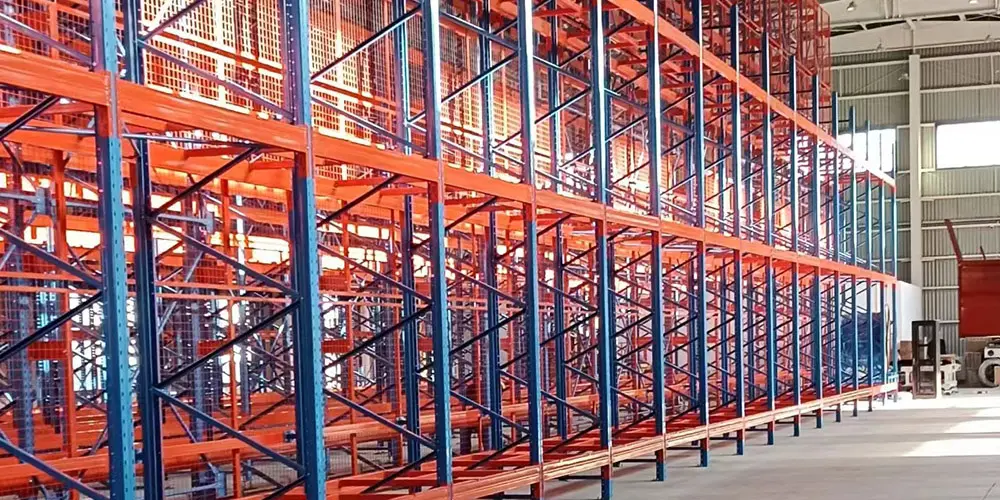
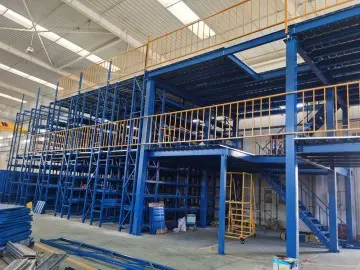
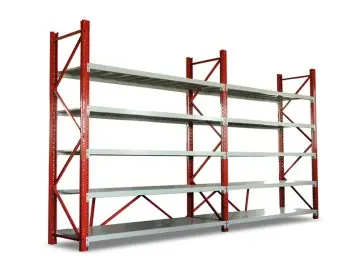
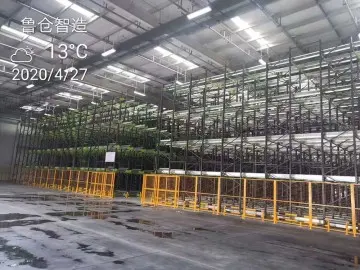
In the modern global supply chain ecosystem, selecting qualified industrial warehouse racking systems from Chinese manufacturers has transitioned from simple commodity purchasing to high-level structural engineering collaboration. Global logistics operators, 3PL providers, pharmaceutical distribution networks, and FMCG cold-chain facilities require strict compliance with international structural safety codes, high volumetric storage efficiency, and seamless handling equipment integration.
Guake Logistics Technology (Shandong) Co., Ltd. (founded in 2010 in Linyi, Shandong, China) stands at the forefront of this industrial transformation. Operating a 20,000+ square meter advanced manufacturing facility with over 100 specialized structural engineers, production technicians, and quality control auditors, Guake delivers comprehensive OEM/ODM warehousing infrastructure globally. This whitepaper systematically articulates the precise engineering parameters, steel grade standards, seismic mitigation principles, and procurement frameworks required when evaluating China warehouse racking factories.
When sourcing heavy-duty racking from Chinese factories, procurement teams must verify the physical and chemical properties of the raw cold-rolled steel coils utilized in production. Structural stability under maximum capacity is directly dictated by yield strength, tensile resilience, and profile geometry.
Chinese steel mills classify structural carbon steel under GB/T standards. Guake utilizes high-grade certified cold-rolled steel plates from top steel plants (such as Baosteel and Shougang Group) to ensure structural integrity across upright profiles and beam sections:
| Steel Grade (GB/T) | International Equivalent | Yield Strength ($f_y$) | Tensile Strength ($f_u$) | Recommended Application |
|---|---|---|---|---|
| Q235B | ASTM A36 / EN SS400 / S235JR | $\ge 235 \text{ MPa}$ | $370 - 500 \text{ MPa}$ | Standard duty racking beams, light/medium shelving, bracing members. |
| Q355B / Q355D | ASTM A572 Gr 50 / EN S355JR | $\ge 355 \text{ MPa}$ | $470 - 630 \text{ MPa}$ | Heavy-duty upright frames, high-bay ASRS columns, cold storage applications (Q355D). |
A reputable Chinese rack manufacturer must engineer layouts that conform to regional structural design codes based on where the racking will be installed:
To resist corrosion in ambient warehouses and humid cold-chain environments, steel members undergo multi-stage automatic surface pretreatment (degreasing, phosphating, acid pickling) followed by electrostatic epoxy-polyester thermosetting powder coating:
Uniform layer thickness between 60 to 80 microns ($\mu\text{m}$), preventing micro-cracking and edge oxidation under stress.
Cross-hatch tape test complying with ISO 2409 Class 0 rating, guaranteeing no paint flaking during forklift loading impact.
Tested under ASTM B117 neutral salt spray test for over 500 hours without red rust initiation.
Matching warehouse operational profiles (SKU density, picking velocity, LIFO vs. FIFO flow) with engineered rack systems.
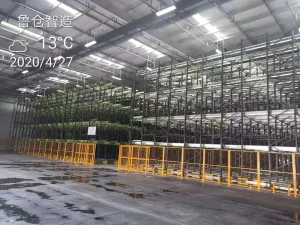
Semi-automated deep-lane storage leveraging battery-powered shuttles. Maximize volumetric space up to 85% utilization while shielding racking frames from forklift collision risks inside storage channels.
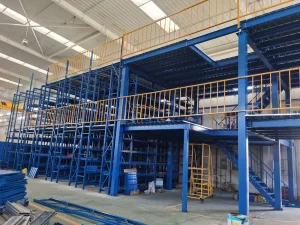
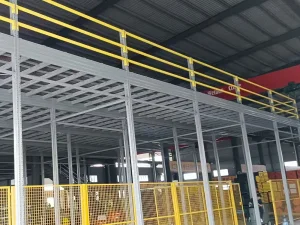
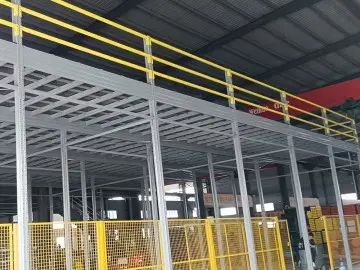
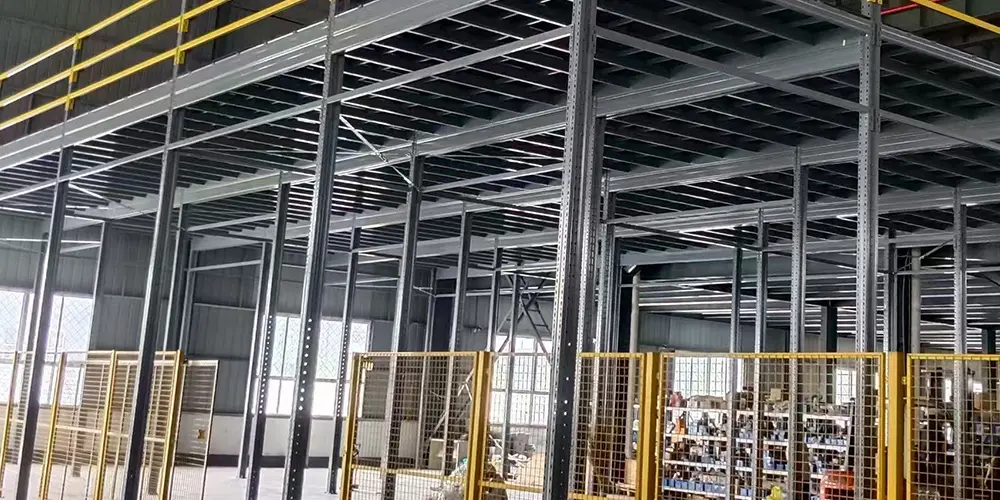
Explore Shuttle Systems →Bolted structural steel platforms turning overhead cubic space into operational floor levels. Designed for floor loads from $300 \text{ kg/m}^2$ to over $1,000 \text{ kg/m}^2$ for e-commerce picking and light assembly.
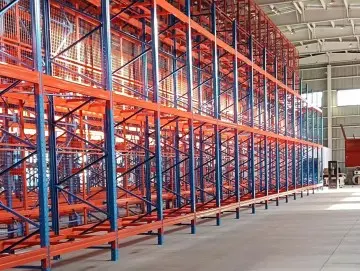
Explore Steel Platforms →Ultra-dense storage systems for homogenous bulk inventory. Drive-In allows forklift entry into deep lanes (LIFO), whereas Push-Back uses nested carts on inclined rails for 2 to 5 deep pallet storage per lane face.
Explore High-Density Racks →For international supply chain managers and project engineers, evaluating a China warehouse racking factory requires rigorous verification across five critical operational dimensions:
Ensure the manufacturer supplies EN 10204 3.1 Mill Test Certificates for every batch of raw steel coils, verifying chemical composition (Carbon, Manganese, Silicon, Phosphorus, Sulfur contents) and mechanical tensile testing properties.
Continuous automatic multi-station cold roll-forming lines ensure that upright profiles have high section modulus accuracy and uniform hole pitch tolerances (less than $\pm 0.5\text{ mm}$ variance over an 11-meter column section).
Beam connector brackets and baseplates must be welded utilizing automated CO2 gas-shielded robotic welding systems. Weld penetration must be verified through Ultrasonic Testing (UT) or Magnetic Particle Testing (MT) to guarantee frame stability under cyclic loading.
Factory load testing rigs should perform full-scale destructive and non-destructive load tests on upright frames and beam assemblies to validate finite element analysis (FEA) computer models.
Global projects require more than standard hardware manufacturing. They require localization support to meet building permit regulations and regional environmental stresses:
In seismic-prone regions (such as the Pacific Rim seismic belt, Western United States, Japan, and parts of Latin America), storage racking structures must be calculated under dynamic earthquake loads. Guake engineers utilize structural modeling software to design heavy-duty footplates, expansion anchor embedded depths, top bracing, and spine bracing systems capable of absorbing lateral shear stress.
To assist overseas clients with local city permit approvals, Guake collaborates with qualified local structural engineering consultants to provide site-specific structural calculations and PE stamps when required by municipal authorities.
Components are bundle-packed with steel strapping, protective plastic wrap, and timber dunnage to resist sea moisture during container shipping. Every shipment includes step-by-step 3D CAD assembly drawings, exploded views, component lists, and video installation guides. For large installations, Guake offers remote engineering support and field guidance.
The industrial storage sector is undergoing rapid modernization. Sourcing teams should align with manufacturers who are actively integrating advanced technology into structural racking systems:
Integrating strain gauges and vibration sensors into critical upright columns to monitor dynamic frame stress and detect forklift impact damage in real-time.
Standardization of lower beam guide rails and bottom clearances to support seamless Autonomous Mobile Robot (AMR) under-pallet retrieval.
Adopting zero-emission recycled structural steel and VOC-free powder coatings to reduce the embodied carbon footprint of warehouse construction.
To assist warehouse planners in choosing the optimal structural system, the following matrix compares storage efficiency, selectivity, operational throughput, and capital investment requirements:
| Racking Architecture | Volumetric Utilization | Pallet Selectivity | Handling Velocity | CAPEX Index | Primary Use Case |
|---|---|---|---|---|---|
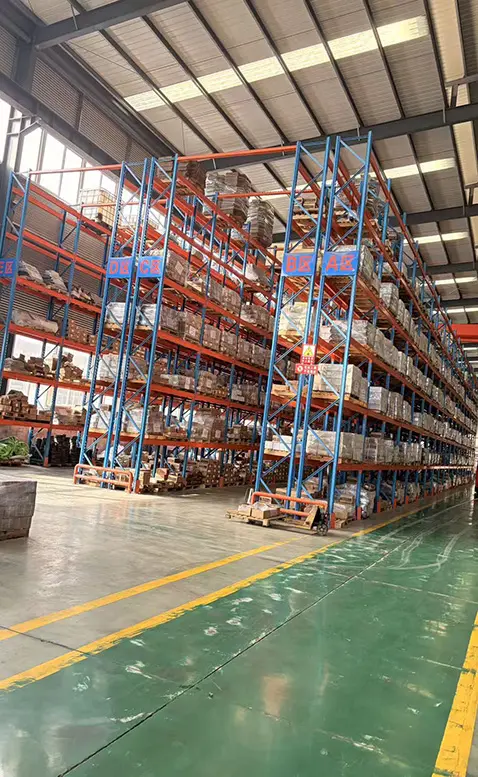
| Selective Pallet Racking | 40% - 50% | 100% Direct Access | High | Low Base | High SKU count, FMCG distribution |
| Drive-In Racking | 75% - 85% | Low (Per Lane LIFO) | Moderate | Moderate | Homogenous bulk goods, cold storage |
| Push-Back Racking | 65% - 75% | Medium (2–5 Deep) | High | Moderate High | Medium SKU counts, quick access |
| Radio Shuttle System | 80% - 90% | High (FIFO / LIFO options) | Very High | High (ROI in 2 yrs) | Cold-chain, high-throughput food & bev |
| Mobile Racking System | 85% - 90% | 100% Selective | Moderate | High | Expensive floor footprint, cold storage |
| Mezzanine Platform | 200% Floor Area | 100% Floor Access | High (Multi-level) | Moderate High | Parts picking, e-commerce fulfillment |
Detailed answers to technical, engineering, purchasing, and installation questions regarding China warehouse racking requirements.
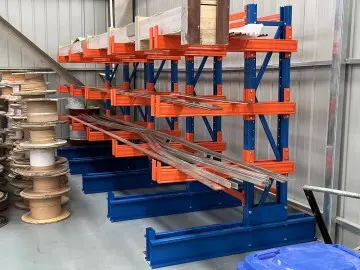
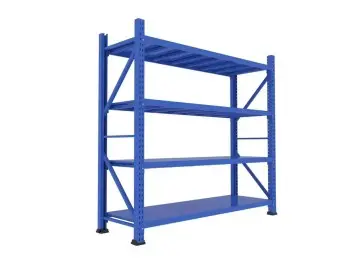
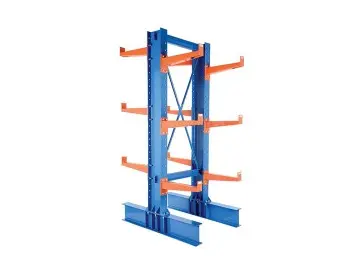
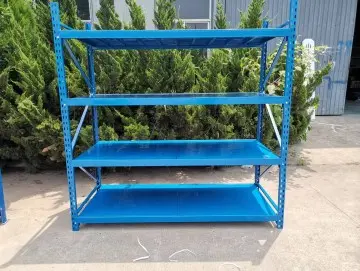
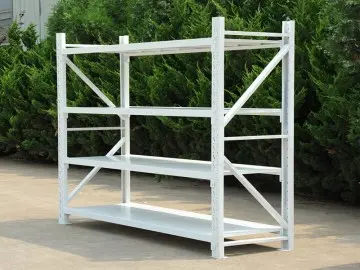
Explore our full engineering line of boltless shelving, cantilever racks for long materials, and multi-tier structural mezzanine platform systems.
Contact the senior engineering team at Guake Logistics Technology (Shandong) Co., Ltd. Submit your warehouse floor plan today for a structural design recommendation, 3D layout, and factory-direct quotation.