Engineered for maximum spatial volumetric efficiency, structural safety, and seamless forklift or robotic compatibility.
In the contemporary global economy, commercial real estate costs and industrial logistics land values have reached unprecedented peaks across North America, Europe, the Middle East, and Asia-Pacific. As logistics hubs demand greater throughput velocity and higher SKU density, enterprise supply chain directors are rapidly shifting focus from horizontal footprint expansion to vertical volumetric footprint optimization. Enterprise warehouse operations no longer evaluate storage systems simply as static steel shelving; today, racking infrastructure serves as the core physical framework supporting sophisticated Material Handling Equipment (MHE), Warehouse Management Systems (WMS), Automated Guided Vehicles (AGVs), and Autonomous Mobile Robots (AMRs).
This industry whitepaper evaluates the industrial capabilities, metallurgical engineering benchmarks, custom manufacturing velocity, and structural integrity offered by leading China warehouse racking solutions manufacturers and factories. Operating at the epicenter of global structural steel manufacturing and advanced roll-forming technology, specialized Chinese logistics hubs—most notably in Shandong province—have transformed how international logistics managers, 3PL operators, cold-chain enterprises, and mega-e-commerce platforms design and procure high-density industrial racking.
Whether deploying low-temperature radio shuttle racks in cold storage environments, multi-tier heavy steel structure mezzanines in e-commerce fulfillment hubs, or automated stereoscopic high-bay ASRS structures, understanding the engineering standards, material sourcing dynamics, and structural calculation methodologies of Chinese manufacturers is essential for achieving optimal Total Cost of Ownership (TCO) and long-term operating safety.
The safety and longevity of warehouse racking systems depend fundamentally on material yield strength, cold roll-forming precision, structural member profiling, and rigorous mechanical testing. Leading Chinese enterprise manufacturers such as Guake Logistics Technology (Shandong) Co., Ltd. enforce strict metallurgical standards aligned with global engineering specifications, including European FEM 10.2.02 (Federation Europeenne de la Manutention), American RMI / ANSI MH16.1 (Rack Manufacturers Institute), and Australian AS4084-2012 standards.
Before cold-formed profiles enter continuous roll-forming lines, structural engineers execute multi-axis FEA simulations. Computer modeling analyzes buckling modes, torsional rigidity, beam deflection under static/dynamic loads, and seismic shear displacement to guarantee structural safety factors exceeding 1.55 to 1.65.
Guake utilizes structural steel coils sourced directly from top-tier state mills (such as Baosteel and Shougang). Standard upright profiles leverage high-yield Q235B (yield strength ≥ 235 MPa) and premium Q355B (yield strength ≥ 355 MPa) steel, providing exceptional ductility under seismic shock loading and heavy pallet loads.
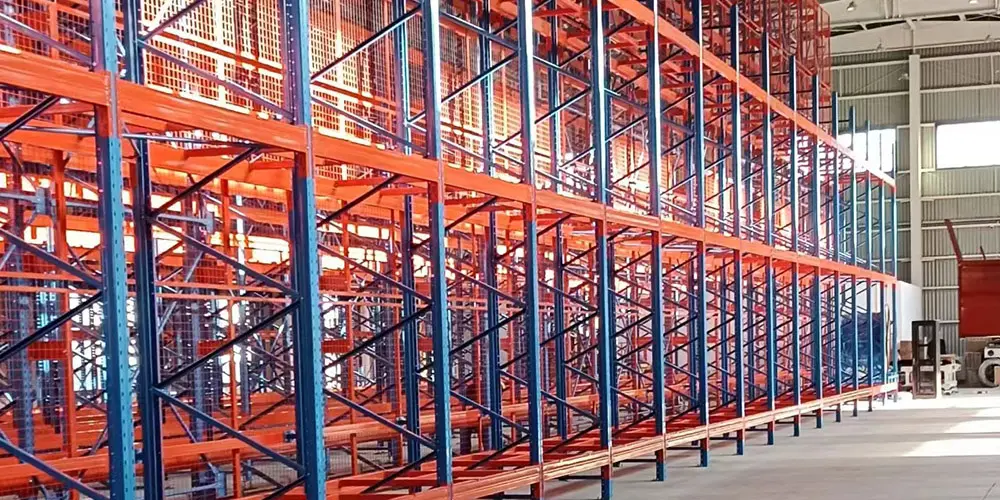
Modern high-bay selective and radio shuttle racking relies on multi-folded upright column profiles (featuring 8 to 13 structural folds per profile side). Folds increase section modulus and inertia without adding excessive dead weight. Upright pitch perforation at 50mm, 52.07mm (2 inches), or 75mm increments is performed on automatic high-speed CNC punching lines, ensuring sub-millimeter hole alignment across 12-meter continuous upright columns. Box beams feature automated robotic welding of beam connectors equipped with safety drop locks to eliminate accidental dislodgements during high-speed forklift operation.
| Steel Grade Standard | Yield Strength ($R_{eH}$) | Tensile Strength ($R_m$) | Elongation ($A_5$) | Primary Application Areas |
|---|---|---|---|---|
| Q235B (GB/T 700) | ≥ 235 MPa | 370 - 500 MPa | ≥ 26% | Light/Medium Shelving, Standard Beams, Decking Panels |
| Q355B (GB/T 1591) | ≥ 355 MPa | 470 - 630 MPa | ≥ 22% | Heavy-Duty Upright Columns, ASRS Structures, Mezzanine Beams |
| SS Grade 50 (ASTM) | ≥ 345 MPa | ≥ 450 MPa | ≥ 18% | Export-Grade Pallet Racking to North American Standards |
| S355JR (EN 10025) | ≥ 355 MPa | 470 - 630 MPa | ≥ 22% | Heavy Industrial Structural Steel Platforms & Mezzanines |
The global dominance of Chinese racking manufacturers stems from deep supply chain integration, raw material proximity, and heavy industrial capital investments in automated continuous roll-forming lines, fiber laser cutting equipment, and automated electrostatic powder coating lines.
Located in Linyi City, Shandong Province—one of China's premier industrial logistics and manufacturing hubs—companies like Guake Logistics Technology (Shandong) Co., Ltd. (founded in 2010) capitalize on an unparalleled manufacturing ecosystem. The key competitive levers driving global procurement preference toward Shandong racking factories include:
Direct integration with major Shandong steel mills eliminates middleman distribution surcharges, ensuring stable raw material pricing and certified chemical heat analysis traceable back to the steel melt shop.
Pre-treatment degreasing, multi-stage acid pickling, silane conversion coating, and high-durability electrostatic epoxy-polyester powder coating (60-90 microns thick) deliver outstanding salt spray corrosion resistance (ASTM B117 > 500 hours).
With multi-line roll-forming capacity, custom structural projects exceeding 500 metric tons can be rolled, punched, welded, painted, packed, and containerized within 15 to 25 production days.
Choosing the right racking configuration involves evaluating Pallet Selectivity vs. Storage Density vs. Operating Throughput speed.
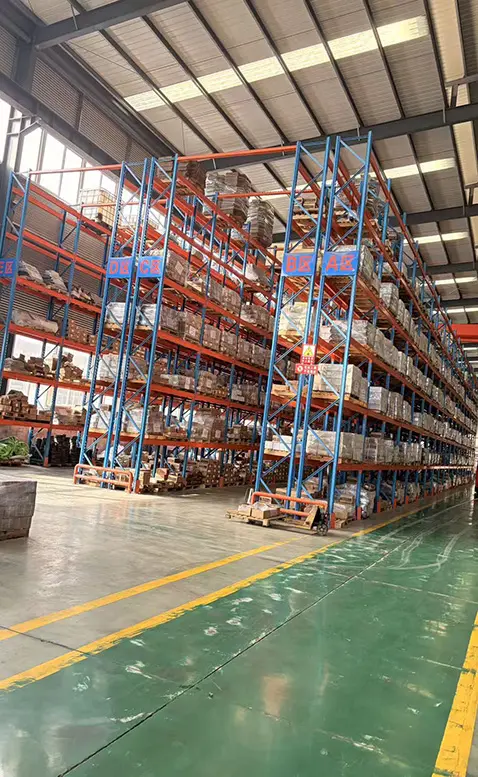
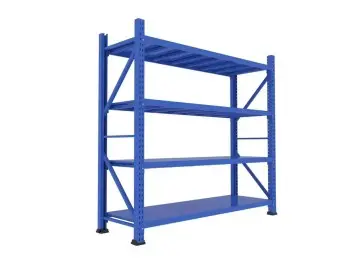
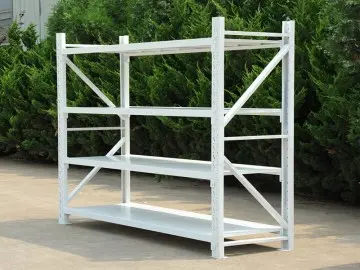
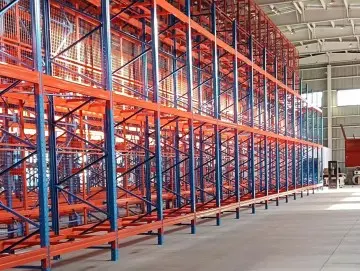
Selective pallet racking represents the foundational standard for warehouse storage across the globe. Constructed with upright frames and pair-interlocking box beams, selective racking delivers 100% immediate pallet access to every single SKU face.
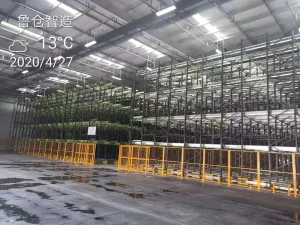
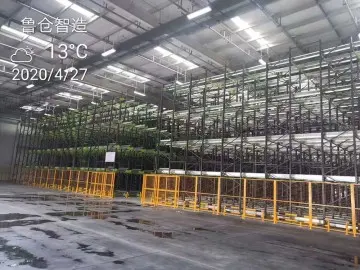
Radio shuttle racking combines ultra-high-density lane storage with autonomous battery-powered pallet runners. The shuttle robot travels inside deep storage channels on specialized guide rails, lifting and moving pallets autonomously.
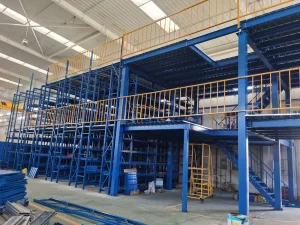
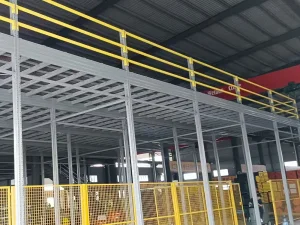
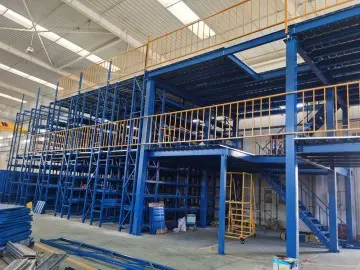
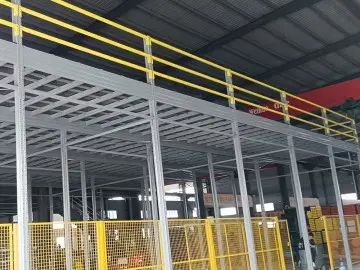
Steel structure platforms and mezzanine racking create multi-tier usable floor levels out of vertical air space, doubling or tripling facility usable square footage without concrete building expansion.
Drive-In racking allows forklifts to enter continuous storage tunnels directly to stack pallets on side support rails. Push-Back racking uses nested sliding carts on inclined rails where incoming pallets push existing ones back (2 to 6 deep).
Industrial racking systems engineered in China are tailored to meet rigorous operational profiles across diverse economic sectors worldwide:
Every cubic meter of sub-zero refrigerated space represents high electrical operating costs. By deploying high-density Radio Shuttle Racking or Motorized Mobile Racking, cold-storage operators increase cubic storage density by 80-85% compared to static selective racks. Hot-dip galvanizing (HDG) treatments prevent structural corrosion driven by thermal condensation cycling.
High-volume pick-and-pack operations require multi-tiered access for thousands of bin locations. Multi-layer Mezzanine Shelving systems feature integrated roller conveyors, automated barcode scanners, and carton flow lanes to maximize item-picking velocity per square meter.
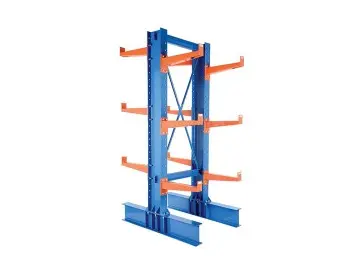
Storing steel tubing, extruded aluminum profiles, heavy timber bundles, and architectural sheet stock requires specialized cantilever architecture. Cantilever Racking engineered by Guake eliminates front vertical columns, providing unobstructed horizontal loading lanes for side-loading forklifts and overhead cranes.
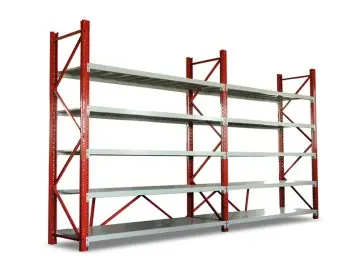
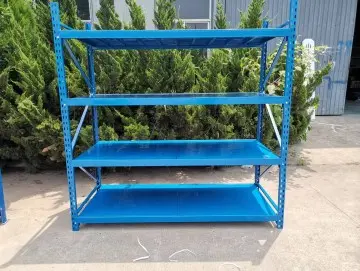
Combining heavy-duty selective pallet racks on lower tiers with medium-duty boltless shelving on mezzanine upper tiers allows 3PL facilities to handle bulky engine blocks and small electrical fasteners within a unified physical footprint.
The global industrial warehouse racking sector is undergoing a profound technological transformation. Key trends driving factory innovation over the next decade include:
Procuring custom warehouse racking solutions from China requires a structured engineering evaluation to guarantee structural safety, local building code compliance, and seamless installation. Global supply chain procurement managers should adhere to the following 5-phase protocol:
| Phase | Procurement Stage | Critical Deliverables & Technical Verification Required |
|---|---|---|
| 01 | Data Collection & CAD Layout | Architectural CAD floor plan, slab load bearing limits ($kN/m^2$), clear building height under truss, pallet dimensions ($W \times D \times H$), unit load gross weight, forklift turning radius. |
| 02 | Structural Design & Calculation | Finite Element Analysis (FEA) dynamic structural calculation report, confirmation of steel grade (Q235B vs Q355B), structural safety factor (≥ 1.55), seismic zone classification compliance. |
| 03 | Factory Quality Audit (QA/QC) | Mill Test Certificates (MTC) for steel coils, ISO9001 certification, CE mark verification, ultrasonic weld inspection, powder coating thickness gauge test (60-90 microns). |
| 04 | Containerization & Export Logistics | Steel bundling with corrugated corner guards, plastic moisture-wrap film, steel strapping, optimal 40ft High-Cube container space utilization plan to prevent transit movement. |
| 05 | Installation & Commissioning | Provision of detailed 3D installation drawings, anchor bolt torque specifications, structural erection sequence, or on-site engineer installation supervision. |
Detailed engineering answers to assist project directors and warehouse planners during system specification.
Explore our full line of industrial heavy-duty pallet racks, cantilever long-goods shelving, and modular metal storage units.
Request our technical product catalog, share your facility CAD drawings, or receive a complimentary structural load calculation from our engineering experts today.