
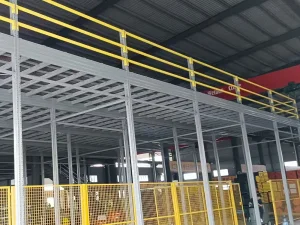


Engineered to FEM 10.2.02 and RMI standards. Browse our core industrial warehouse systems deployed across global logistics hubs.
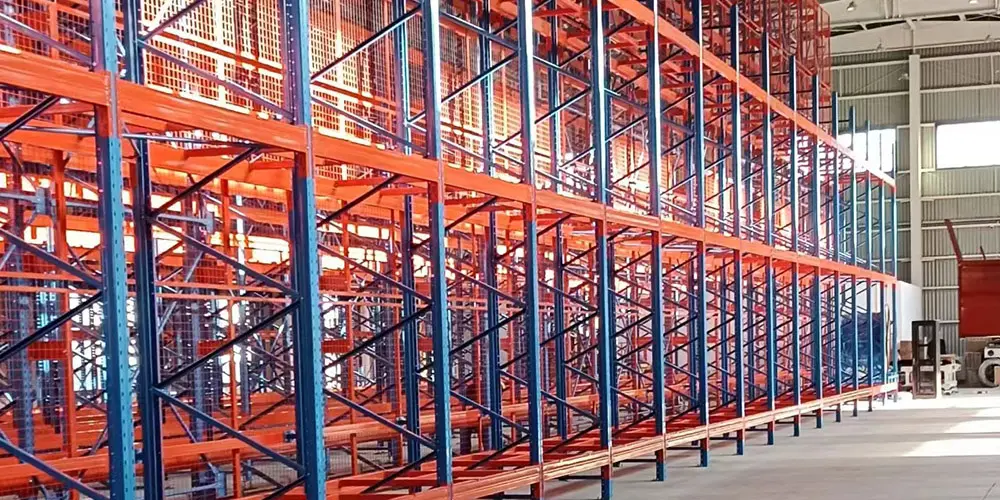
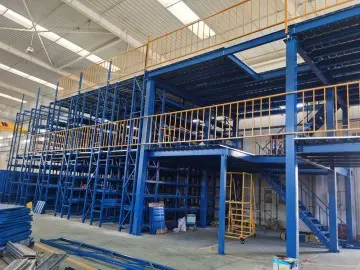
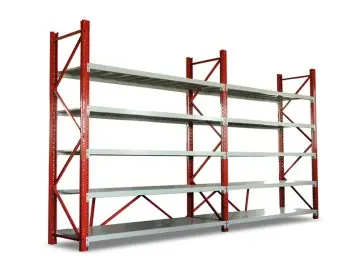
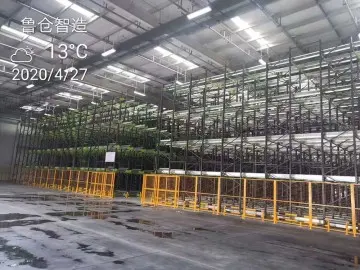
In an era defined by industrial land scarcity, rising prime logistics real estate rents, and rapid omni-channel fulfillment cycles, global logistics operators are forced to rethink structural footprint efficiency. Industrial real estate lease rates across North America, Western Europe, and Asia-Pacific have escalated significantly over the past decade. For 3PL operators, cold storage developers, and automotive manufacturers, horizontal expansion is often financially unviable or geographically impossible. Consequently, the focus has shifted from standard square-meter footprint management to cubic-meter volumetric yield engineering.
As a premier China warehouse solutions manufacturer based in Linyi, Shandong, Guake Logistics Technology (Shandong) Co., Ltd. sits at the intersection of heavy structural steel fabrication and smart automation technology. China's manufacturing ecosystem has evolved from producing basic selective pallet racks to engineering integrated, high-bay automated storage and retrieval structures, multi-tier heavy structural platforms, and semi-automated radio shuttle grids capable of operating under harsh environmental conditions.
Global procurement directors often incur a 40% to 60% price premium when sourcing structural racking exclusively through localized system integrators. By partnering directly with Chinese original equipment manufacturers (OEMs) that possess certified structural calculation capabilities, global clients maintain exact adherence to local building codes (RMI ANSI MH16.1, FEM 10.2.02, AS4084-2012) while reducing capital expenditure (CapEx) per pallet position by up to 35%.
Understanding international building codes is paramount when procuring warehouse solutions from China manufacturers. The structural integrity of industrial racking must account for frame buckling, beam deflection, beam-column connection stiffness, and seismic lateral drift.
| Region / Standard | Governing Structural Body | Beam Deflection Limit | Safety Factor Requirements | Seismic & Impact Criteria |
|---|---|---|---|---|
| North America (ANSI MH16.1) | Rack Manufacturers Institute (RMI) | L / 180 of clear span | 1.65 (Steel design yield basis) | Seismic Response Modification Factor ($R=4.0$), Peak Ground Acceleration (PGA) compliance |
| Europe (EN 15512 / FEM 10.2.02) | European Federation of Materials Handling | L / 200 (Pallet) / L / 300 (Automated) | Partial factor $\gamma_m = 1.15$ for structural steel | EN 16681 seismic action design, 0.5% horizontal force allowance ($F_h = 0.005 F_v$) |
| Australia (AS 4084-2012) | Standards Australia | L / 200 of clear beam span | Structural limit state design methodology | Mandatory frame upright protection, bottom beam height ground clearance controls |
| China (GB/T 28576 / ISO 9001) | National Standardization Administration | L / 200 under maximum design payload | 1.55 – 1.65 load multiplier | GB 50011 seismic design of buildings, high-strength cold-formed steel validation |
Selecting the optimal warehouse storage architecture requires balancing three dynamic variables: Storage Density (Cubic Volumetric Rate), Pallet Selectivity (Immediate SKU Accessibility), and Throughput Speed (Pallet Moves per Hour). Below is an engineering evaluation of the primary storage topologies manufactured by China factories.
Selectivity: 100% | Density: Baseline | Flow: FIFO/LIFO
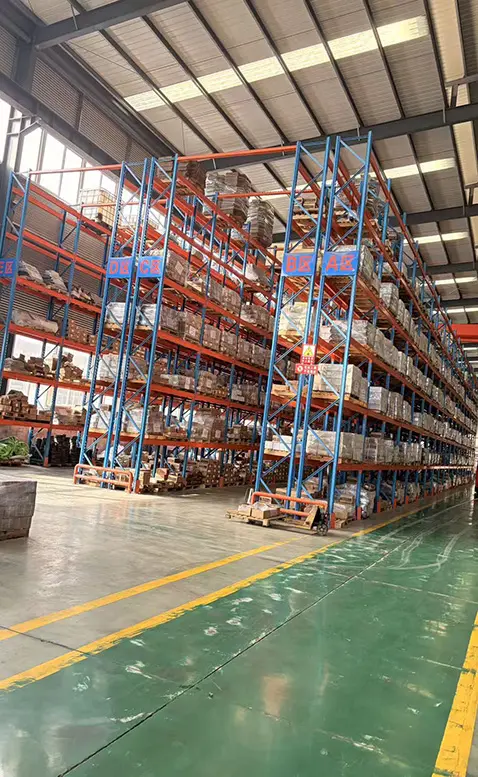
Constructed using cold-formed omega-profile upright columns ($80\times60\text{mm}$ to $120\times95\text{mm}$) and interlocking box beams with multi-claw safety connectors. Heavy-duty selective racking allows direct, unhindered access to every single pallet position.
Selectivity: Per Lane | Density: Very High | Flow: FIFO or LIFO
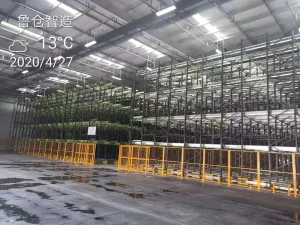
A semi-automated deep-lane storage system utilizing an autonomous battery-powered shuttle car running inside galvanized guide rails. Forklifts place pallets at the lane entry, and the shuttle independently transports and deposits pallets deep within the rack.
Space Multiplication: 200% – 300% | Application: Picking / Offices
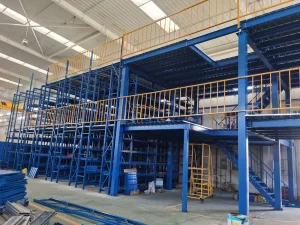
Heavy structural steel platforms engineered using hot-rolled H-beams, cold-formed floor purlins, and specialized steel decking (solid checkered plate, perforated plate, or galvanized steel grating). Creates additional operational floor levels without physical building extension.
Selectivity: Low | Density: Ultra-High | Flow: LIFO (Drive-In) / FIFO
Designed for bulk storage of uniform SKUs. Forklifts physically drive into continuous racking lanes to deposit pallets on continuous cantilever arms and floor-to-top rails, eliminating working aisles.
Selectivity: High per Lane | Density: 2–6 Pallets Deep | Flow: LIFO
Pallets rest on nested carts moving along inclined steel tracks. When a new pallet is loaded from the aisle face, it pushes existing pallets backward. Upon retrieval, gravity gently slides the remaining pallets forward to the aisle face.
Selectivity: 100% On-Demand | Density: Extremely High | Flow: Flexible
Conventional selective racks mounted onto heavy-duty motorized bases that slide horizontally along embedded floor rails. Only one working aisle opens at a time via remote control or WMS command, eliminating unnecessary aisle space.
The competitiveness of China warehouse equipment manufacturers stems from geographical industrial clustering. Located in Linyi, Shandong Province, Guake Logistics Technology leverages direct proximity to major Chinese steel mills (including Baosteel, Shandong Iron & Steel Group, and Laiwu Steel). This raw material proximity secures high-tensile Q235B and Q355B cold-rolled steel coils with transparent traceability and minimal inland freight overhead.
Our facilities utilize continuous 18-station cold roll-forming lines. Upright columns undergo precision automated punching, multi-pass profile forming, and hydraulic shearing, ensuring structural tolerances within $\pm 0.5\text{mm}$ across a 12-meter continuous upright frame.
Beam connector claws and structural column baseplates are welded using multi-axis ABB robotic welding cells. Automated CO2 gas-shielded arc welding ensures deep joint penetration, zero slag inclusion, and uniform bead aesthetics capable of withstanding heavy dynamic dynamic loads.
Components undergo an 18-stage surface pre-treatment process, including alkaline degreasing, acid rust removal, zinc-phosphate conversion coating, and pure water rinsing, followed by electrostatic epoxy-polyester powder coating cured at 200°C.
| Inspection Parameter | Standard Specification | Guake Internal Quality Protocol |
|---|---|---|
| Coating Thickness | ISO 2178 / ASTM B499 | 70 – 100 microns ($\mu\text{m}$) uniform electrostatic application |
| Cross-Hatch Adhesion | ISO 2409 / ASTM D3359 | Class 0 (No detachment of square lattices under tape test) |
| Salt Spray Corrosion Resistance | ASTM B117 Neutral Salt Spray | Passed 500+ hours with zero creepage from scribed line |
| Impact Resistance | GB/T 1732 / ISO 6272 | 50 kg·cm impact force with zero cracking or flaking |
| Steel Grade Yield Strength ($f_y$) | GB/T 1591 / EN 10025 | Q355B $\ge 355\text{ MPa}$; Q235B $\ge 235\text{ MPa}$ mill certified |
Storage racking is not a commodity; it is an engineered subsystem tailored to operating environments. Below are specialized localized scenarios where custom China warehouse solutions deliver distinct operational performance gains.
Challenge: Extremely high energy costs per cubic meter and low-temperature steel embrittlement.
Solution: High-density Radio Shuttle or Motorized Mobile Racking built from low-temperature alloy steel (Q355D grade) resistant to brittle fracture. Specialized lithium-iron-phosphate ($LiFePO_4$) batteries with internal heating elements ensure continuous 8-hour shuttle cycles inside freezing environments.
Challenge: Rapid unit picking of thousands of high-velocity SKUs with tight order cut-off times.
Solution: Multi-tier steel platform mezzanines integrated with carton flow tracks, pick-to-light indicators, and automated spiral chute conveyors. Increases vertical pick face density by 300% without expanding facility footprint.
Challenge: Storing heavy engine blocks, body panels, and long structural extrusions safely.
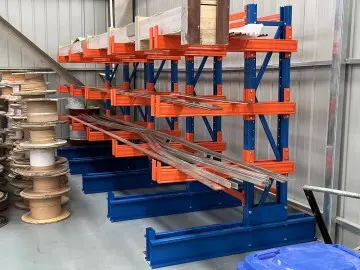
Solution: Heavy-duty cantilever racking combined with customized structural steel platform racks. Unobstructed arm access allows side loading via side-loader forklifts or overhead cranes, with unit arm load capacities rated up to 1,500kg per arm.
The future of warehouse solutions lies in the convergence of passive structural steel frames with active robotics, IoT telemetry, and artificial intelligence. Guake Logistics Technology is actively driving development across four strategic technological vectors:
Transitioning from standard single-axis radio shuttles to multi-directional 4D shuttles capable of changing lanes and switching vertical levels via integrated lifters. This completely eliminates human forklift intervention inside high-density storage matrix structures.
Embedding wireless piezoelectric strain gauge sensors and MEMS accelerometers into critical rack upright bases. Real-time dynamic strain monitoring triggers instant alerts for structural overload or accidental forklift impacts, preventing catastrophic rack collapse.
Integrating WMS/WCS software protocols directly with automated storage hardware. Machine learning algorithms re-balance inventory positioning during off-peak hours, bringing high-velocity SKUs closer to dispatch points to minimize travel time.
Executing an overseas warehouse installation requires strict adherence to project engineering milestones. Guake provides end-to-end accountability through a standardized 5-phase project management methodology.
Detailed facility analysis including floor slab load capacity ($kN/m^2$), clear building height under trusses, column spacing, and sprinkler pipe elevations.
Engineering modeling using Finite Element Analysis (FEA) software to verify frame stability, dynamic beam deflection limits, and localized seismic coefficient factors.
Automated roll-forming, laser cutting, robotic welding, and electrostatic powder coating under strict ISO 9001 quality management inspection.
Steel components are bundled in protective steel frames, corner-wrapped with corrugated cardboard, and stretch-filmed to prevent ocean freight transit corrosion.
Complete assembly documentation, 3D CAD step-by-step guides, and dispatch of senior installation engineers or remote AR-guided technical support.
Explore our complete range of customized warehouse storage solutions manufactured directly in Shandong, China.
Detailed technical and commercial answers compiled by senior structural engineers at Guake Logistics Technology.
To prepare an engineered CAD layout and precise cost estimate, our structural engineering team requires:
Chinese structural steel standard GB/T 1591 directly corresponds to European EN 10025 standards:
Standard factory manufacturing lead times range from 20 to 30 working days following engineering drawing sign-off and deposit receipt. Shipping is typically routed through Qingdao Port (one of China's largest deep-water container ports located 3 hours from our Shandong plant), offering direct sea transit times of 14–18 days to the US West Coast, 28–35 days to European main ports, and 10–14 days to Southeast Asia.
In accordance with RMI ANSI MH16.1 and EN 16681 standards, seismic design accounts for ground acceleration forces acting on upright frames. We calculate frame dynamic stiffness, employ heavy-duty floor baseplates anchored with chemical anchor bolts (M12 to M16), and install vertical and horizontal bracing towers to distribute lateral shear forces during seismic events.
Yes. We work in tandem with licensed third-party structural engineering firms across North America, Australia, and Europe. Our internal engineering team generates full finite element stress models and structural calculation sheets, which are then submitted to licensed regional Professional Engineers (PE) for localized building permit certification and stamping.
For standard dry indoor storage, our 70-100 micron electrostatic powder coating provides durable protection. For aggressive environments—such as high-humidity coastal warehouses, fertilizer storage, or chemical processing plants—we recommend Hot-Dip Galvanizing (HDG) in accordance with ISO 1461. Hot-dip galvanizing deposits a 60–85 micron zinc layer inside and outside tubular sections, offering decades of maintenance-free corrosion resistance.