Engineered for heavy-duty structural load-bearing capacity, rapid global deployment, and spatial optimization across international supply chains.
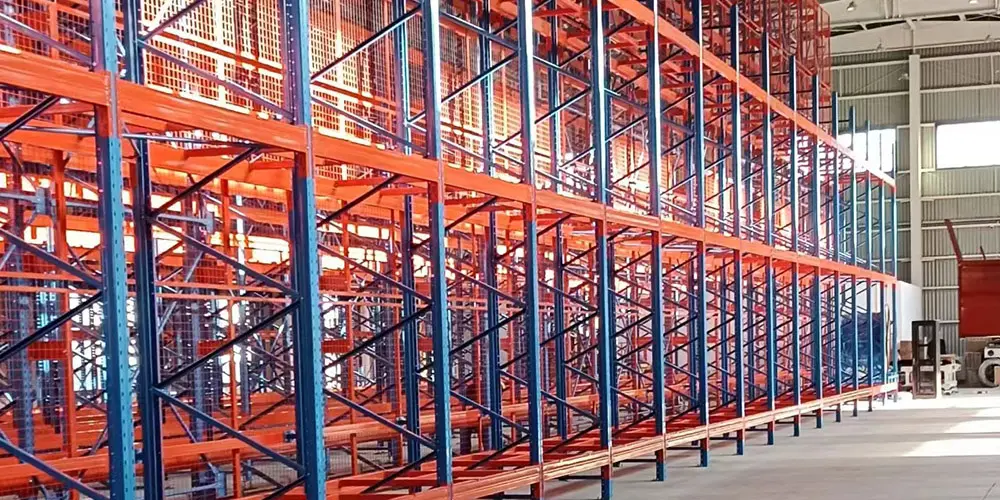
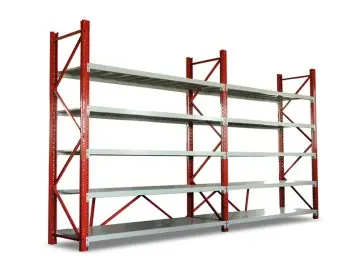
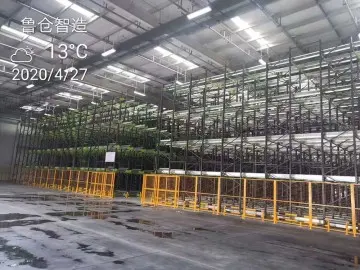
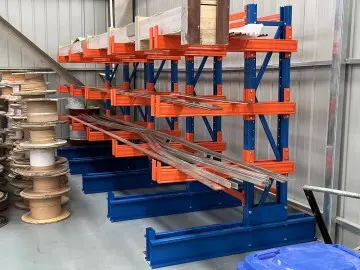
Understanding spatial economics, volumetric utilization efficiency, and structural safety parameters in an era of skyrocketing industrial real estate valuations.
With global commercial warehouse rents increasing by 8.4% year-over-year across key logistics corridors in North America, Western Europe, and Asia-Pacific, enterprise supply chain directors can no longer rely on horizontal facility expansion. Vertical storage density optimization is now a primary financial lever for protecting EBITDA margins.
Modern wholesale materials storage rack platforms are no longer static steel structures. They serve as physical structural skeletons for automated guided vehicles (AGVs), radio shuttles, and AS/RS crane integration. Structural tolerances must comply with millimeter-level precision to ensure zero-collision automated operations.
Global procurement standardizations mandate high seismic tolerance, corrosion resistance, and modular structural adaptability. Wholesale materials storage rack suppliers must deliver structural certifications (such as FEM, RMI, and EN standards) to mitigate operational risk across diverse geographic deployments.
Technical specifications, steel grade selection, and structural safety certifications required for international commercial projects.
High-performance materials storage rack manufacturing starts with cold-rolled steel profiling. Premium factories utilize Q235B and high-yield Q355B structural cold-rolled steel plates (yielding strength $\sigma_y \ge 355 \text{ MPa}$). Upright columns undergo continuous multi-stage cold roll-forming to ensure uniform stress distribution along perforated profile edges, preventing micro-fractures under heavy static load conditions.
Enterprise procurement officers must ensure that wholesale suppliers strictly comply with international racking safety standards to satisfy local building codes and industrial insurance policies:
How Shandong’s advanced steel manufacturing clusters drive lower total cost of ownership (TCO) without compromising structural integrity.
Modern Shandong racking factories incorporate fully automated cold roll-forming lines, 3D fiber laser cutting units, and robotic arc welding cells. Computer numerical control (CNC) punching ensures structural hole alignment accuracy within $\pm 0.2\text{mm}$, reducing assembly friction and dynamic structural stress during on-site installation.
Surfaces undergo 9-stage pre-treatment cleaning, including phosphating, rust removal, and ultrasonic washing, followed by automated electrostatic epoxy powder coating. The resulting surface layer ($60\mu\text{m} - 90\mu\text{m}$ thickness) delivers high scratch resistance, anti-corrosion properties, and chemical stability across diverse warehouse conditions.
Proximity to China’s major steel mills (such as Baosteel, Shougang, and Laiwu Steel) allows suppliers to secure raw steel coils at direct mill prices. This eliminates multi-tier intermediate distributor margins and shields international buyers from erratic spot-market material cost spikes.
Matching pallet selectivity, handling velocity, and load profiles to the ideal structural rack layout.
Eliminating traditional aisles, forklifts enter structural lanes directly to deposit unit loads on continuous support rails. Ideal for high-density storage of homogeneous SKUs, bulk raw materials, and cold-chain facilities operating on a Last-In, First-Out (LIFO) inventory model.
Utilizing nested inclined cart platforms operating on internal steel rails, push-back racking enables 2 to 6 pallet deep storage per aisle face. As a new pallet is loaded, it pushes previous units back; upon retrieval, gravity feeds remaining units forward automatically.
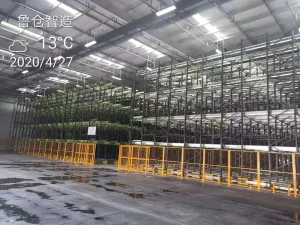
Semi-automated radio shuttles traverse internal guide channels to carry pallets inside deep lanes. Controlled remotely, shuttles allow high-throughput operational speeds, reduced forklift collision risk, and support both FIFO and LIFO inventory strategies.
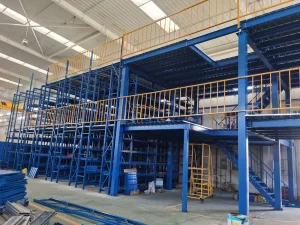
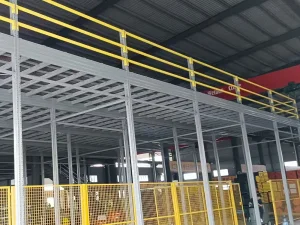
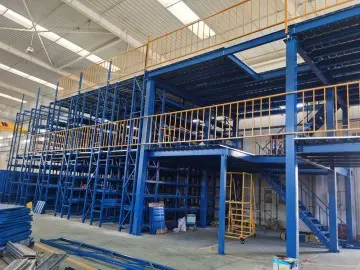
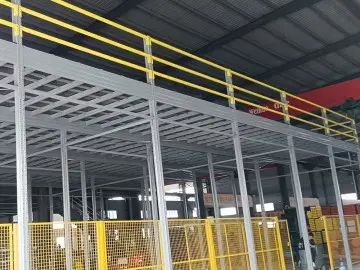
Heavy-duty structural platforms double or triple usable floor square footage by building upward. Bolted steel columns, primary steel girders, and secondary purlins support floor loads ranging from $300\text{ kg/m}^2$ to over $1,500\text{ kg/m}^2$ for picking, sorting, or office use.
Heavy-duty racking blocks mounted on motorized mobile bases running on embedded floor tracks. Systems open single working aisles on demand via automated PLC control, delivering 100% pallet selectivity while doubling storage capacity within the same footprint.
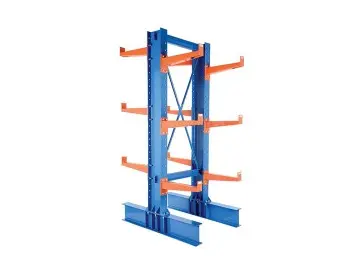
Designed without front vertical columns, cantilever racks provide unobstructed side-loading access for storing long, heavy, or irregular materials such as steel pipes, aluminum extrusions, timber bundles, plastic tubing, and sheet metal plates.
Custom structural engineering adapted to specialized industrial and commercial operating environments.
Low-temperature environments require high dynamic storage density to offset intense refrigeration utility costs. Wholesale radio shuttle racking and drive-in systems manufactured with low-temperature carbon steel prevent cold brittleness and structural fatigue. Specialized powder coatings prevent condensation corrosion on structural connections.
Multi-tier mezzanine shelving platforms combined with integrated gravity flow racks enable high-density piece-picking operations. Dedicated conveyor channels, integrated safety netting, and stairs optimize order picking speeds while segregating manual inventory replenishment from outbound packing areas.
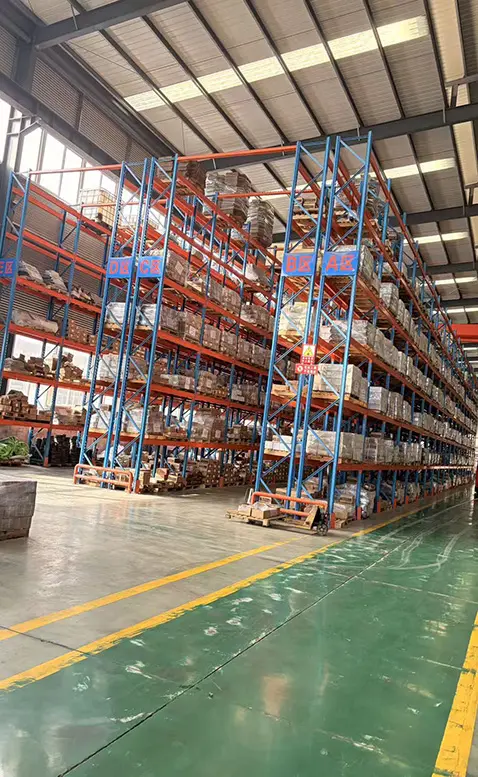
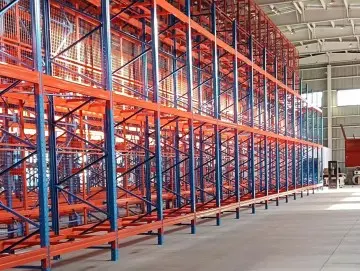
Storing engine blocks, stamping dies, and heavy metal components demands robust heavy-duty selective pallet racking fitted with custom steel wire decking, support bars, or drop-in corrugated steel plates engineered for concentrated point loads exceeding 4,000 kg per level.
Fitted with integrated liquid containment spill sumps, chemical-resistant hot-dip galvanizing finishes (ISO 1461), and anti-spark plastic support profiles, specialized materials storage racks protect facilities against chemical degradation, flammability risks, and environmental compliance penalties.
Evaluate density, accessibility, inventory flow, and investment metrics side-by-side to determine optimal facility design.
| Rack Architecture | Storage Density | Pallet Selectivity | Inventory Flow | Forklift Aisle Demand | CAPEX Level |
|---|---|---|---|---|---|
| Selective Pallet Rack | Moderate (40%) | 100% Direct Access | FIFO / LIFO | Standard (3.0m - 3.5m) | Low |
| Drive-In Racking | Very High (75%) | Low (Per Lane) | LIFO Standard | Minimum (Entrance only) | Moderate |
| Push-Back Racking | High (65%) | Moderate (Lane face) | LIFO | Reduced (Single Aisle) | Moderate - High |
| Radio Shuttle System | Maximum (85%) | Semi-Automated | FIFO or LIFO | External Loading Aisle | High (Automation) |
| Mobile Racking | Very High (80%) | 100% On-Demand | FIFO / LIFO | Dynamic Single Aisle | High (Motorized) |
| Mezzanine Platform | Floor Doubling | Manual / Pick Face | Flexible | Stairs / Vertical Lifts | Moderate |
| Cantilever Racks | High for Long Goods | Direct Side Access | Flexible | Side Loader / Reach Truck | Moderate |
Direct expert answers to common engineering, purchasing, and shipping questions from global buyers.
Our engineering team performs finite element analysis (FEA) modeling customized to local seismic acceleration zones (Sds parameters), soil classes, and building codes (ANSI/RMI MH16.1 or FEM 10.2.02). Heavy-duty seismic base plates, expansion anchor bolts, and cross-bracing structural frameworks are engineered specifically to absorb dynamic ground displacements.
We source certified prime cold-rolled steel coils directly from tier-1 steel mills (Baosteel, Shougang). Upright profiles utilize Q235B or Q355B high-strength structural grade steel. Mill test certificates (MTC) verifying chemical composition, yield strength ($\ge 355\text{ MPa}$), and elongation properties are provided with every shipment batch.
Standard production turnaround for standard container orders (e.g., 2 to 5 40ft HQ containers) is 15 to 25 business days. Customized radio shuttle systems or specialized multi-tier mezzanine platforms requiring custom tooling typically take 25 to 35 days from final CAD drawing approval.
Yes. We provide complete 2D architectural CAD layouts, 3D spatial renderings, and structural structural loading calculation reports free of charge. Buyers only need to submit basic building floor plans, clear overhead clearance measurements, pallet load dimensions, and forklift operating specs.
Upright frames and beam components are bound with heavy-duty steel strapping, protective cardboard corner guards, and wrapped in thick waterproof poly-film. Small hardware, connectors, safety pins, and bolts are packaged in reinforced wooden cases or heavy corrugated cartons to prevent transit damage.
Every project is shipped with detailed, step-by-step installation manuals, component identification lists, and 3D assembly diagrams. For large-scale projects, we can send experienced structural installation engineers to supervise local labor, conduct quality audits, and oversee system commissioning.
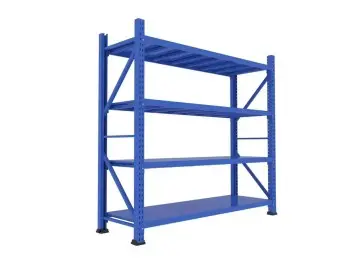
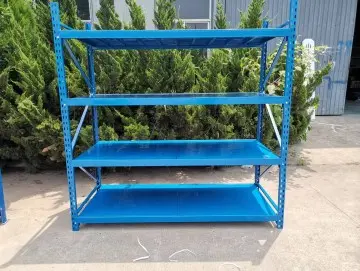
Browse our full range of heavy-duty pallet racks, cantilever arrays, boltless shelving, and platform structures.
Ready to optimize your facility's spatial density and structural efficiency? Contact our engineering design team to receive CAD layouts, structural calculations, and direct factory pricing within 24 hours.