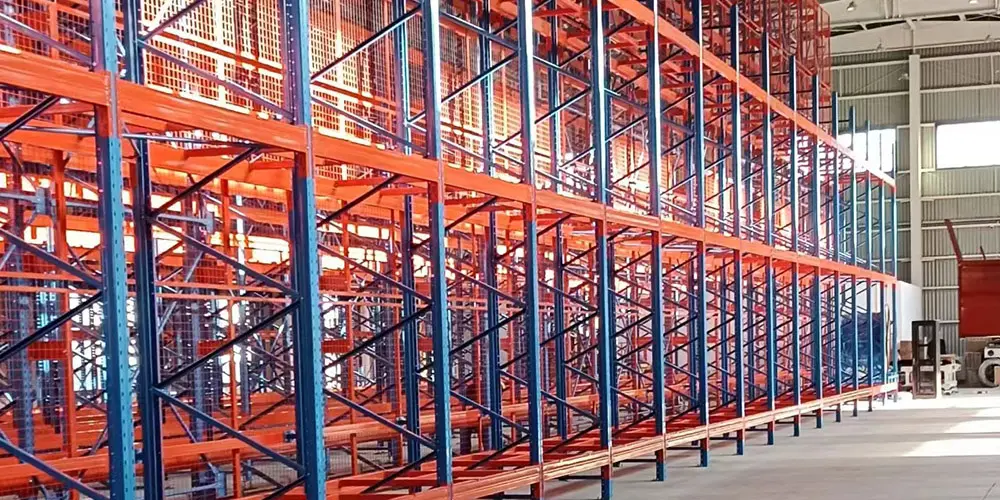
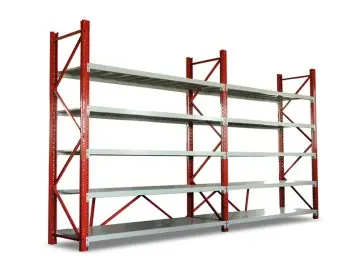
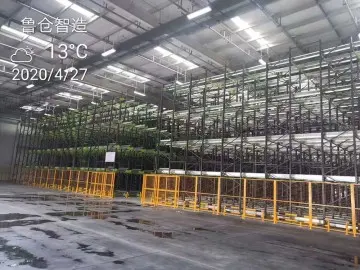
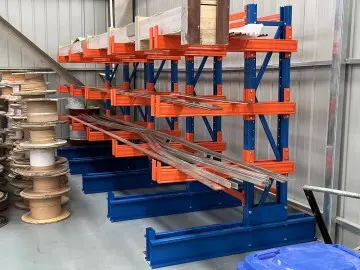
In contemporary supply chain logistics, warehouse real estate cost inflation has forced industrial operators to transition from horizontal footprint expansion to vertical spatial optimization. Maximizing cubic storage utilization while maintaining rigorous safety standards hinges entirely on precise engineering calculations and accurate storage rack dimensions. Sourcing from experienced wholesale storage rack dimensions suppliers allows enterprise procurement teams to bridge structural integrity, localized fire codes, and handling equipment capabilities.
Improper dimensional specification of industrial racking leads to two severe operational penalties: unutilized vertical void space or catastrophic aisle interference with material handling equipment (MHE). Miscalculated frame depths by even 50mm can cause pallet instability, standard overhang failures, or structural buckling under peak load capacities. Enterprise buyers must evaluate dimensional metrics not merely as catalog listings, but as engineered structural parameters.
Navigating international B2B procurement demands transparent OEM direct manufacturing partnerships. Sourcing standardized or custom storage rack dimensions directly from Chinese logistics tech hubs, such as Guake Logistics Technology in Shandong, eliminates multi-tier middleman markup while guaranteeing compliance with global structural standards including ANSI/RMI MH16.1, FEM 10.2.02, and EN 15512.
To achieve optimal engineering performance, every warehouse racking layout relies on three core dimensional axes: Vertical Upright Frame Height, Horizontal Load Beam Length, and Depth-of-Frame Geometry. Below is the structural calculation methodology used by certified rack engineers.
Upright frame height is determined by taking the maximum clear height under ceiling joists (or sprinkler heads) minus a minimum mandatory top-of-load clearance of 450mm to 600mm. Upright columns feature cold-rolled teardrop or omega profiles with adjustable pitch increments of 50mm, 75mm, or 3 inches (76.2mm).
Beam length is the clear distance between two upright columns. It must accommodate the nominal pallet width plus required operational side-clearance tolerances. Standard practice allocates 75mm to 100mm clearance between upright posts and pallets, and 100mm between adjacent pallets.
Upright depth must allow pallet stringers or bottom deckboards to rest securely on both front and rear load beams. The global gold standard mandates a nominal 75mm (3-inch) pallet overhang at both front and back faces to ensure full beam engagement and visual inspection for forklift operators.
Racks are not passive metal shelves; they are flexible structural steel frames subjected to dynamic forces, eccentric vertical loading, impact forces from forklifts, and seismic movement. Reliable wholesale storage rack dimensions suppliers must perform rigorous stress analysis on every engineered layout.
| Dimensional Metric | Standard Range (Metric) | Standard Range (Imperial) | Engineering Safety Impact |
|---|---|---|---|
| Unbraced Height (L_u) | 1,200mm - 2,200mm | 47" - 86" | Controls maximum slenderness ratio ($K L / r$) and upright buckling limit. |
| Beam Deflection Ratio | L / 180 (Standard) | L / 180 (ANSI/RMI) | Prevents permanent beam deformation and deck pop-out hazards under full payload. |
| Flue Space Width | 150mm - 300mm | 6" - 12" | Ensures NFPA 13 compliance for vertical fire sprinkler water penetration. |
| Baseplate Thickness | 6mm - 12mm | 0.25" - 0.50" | Distributes point load safely to concrete slab; engineered for seismic zones 1-4. |
| Aisle Clearance (VNA) | 1,600mm - 1,800mm | 63" - 71" | Optimized for turret trucks / wire-guided automatic handling equipment. |
Beam-to-column connections govern the moment resistance of pallet racks. Wholesale storage rack dimensions suppliers design multi-prong drop-in connectors (typically 3 or 4 hooks) with automatic safety pins. This structural connection resists horizontal shearing forces caused by sway and emergency braking of material handling equipment.
In active seismic zones (such as California, Japan, Chile, or Turkey), standard floor anchorage is insufficient. Upright frame depth calculations must incorporate oversized seismic footplates with dual wedge anchors (1/2" or 5/8" diameter), transferring horizontal tension and shear stresses cleanly into the reinforced concrete foundation slab.
When procuring storage racks globally, enterprise procurement managers must align direct OEM dimensional specifications with local structural building codes. China manufacturers like Guake Logistics Technology engineer rack profiles to comply across all major global regulatory frameworks.
Published by the Rack Manufacturers Institute, RMI governs steel storage rack design across the United States. It specifies mandatory 3-inch teardrop punching patterns, maximum unit load capacity labels, strict upright baseplate anchor calculations, and $L/180$ maximum beam deflection criteria under full structural load.
The European Federation of Materials Handling (FEM) and EN 15512 mandate limit-state design principles. Steel yield stress factors, partial safety factors for loads ($\gamma_f$), and strict global lateral sway checks ensure structural stability across multi-tier mezzanine and high-bay racking systems.
AS 4084 dictates stringent testing protocols for beam-to-upright connectors and column baseplates across Australia. Sourcing rack dimensions tailored for Australian standards requires specialized 50.8mm pitch punching and high-visibility safety orange beam finishing.
China’s industrial logistics equipment sector—centered in Shandong Province—provides global buyers with unmatched manufacturing scale, rapid custom prototyping, advanced automated production lines, and direct raw material cost integration.
Guake Logistics Technology utilizes premium hot-rolled Q235B and Q355B structural steel strip supplied directly by tier-one state-owned steel mills. Continuous automated cold roll-forming lines process upright profiles with micro-tolerances within ±0.2mm, preventing structural twist, eccentricity, or pitch misalignment along 12-meter upright lengths.
Load beam end-plates are joined using automated ABB robotic MIG welding arms, guaranteeing deep weld penetration and zero human error. Components undergo a multi-stage pre-treatment wash followed by thermosetting powder coating baked at 200°C, providing superior impact, scratch, and corrosion resistance for demanding cold-storage and high-humidity environments.
Wholesale order economics depend heavily on shipping container space optimization. Guake’s engineering team designs rack components to nest compactly inside 40ft High Cube (40HQ) ocean containers. Upright frames are supplied knocked-down (KD) with bolted bracing sets, maximizing steel payload weight (up to 26 gross metric tons per container).
Unlike Western catalog distributors tied to rigid standard stock sizes, Chinese OEM manufacturers offer flexible tooling adjustments. Upright heights, beam profiles, hole pitch dimensions, baseplate dimensions, and custom RAL color finishes can be tailored to match your precise facility requirements without extended lead times.
Warehouse storage rack dimensions are directly governed by regional pallet standards and industry-specific operational workflows. Sourcing racks tailored to specific market requirements prevents operational bottlenecks.
The North American market is dominated by the standard GMA pallet (1,219mm x 1,016mm). The industry-standard rack configuration specifies a 42-inch (1,067mm) upright frame depth paired with 96-inch (2,438mm) or 108-inch (2,743mm) selective beam lengths, leaving 3 inches of front/rear pallet overhang.
European logistics operations utilize EPAL 1 (800mm x 1,200mm) and EPAL 2 (1,000mm x 1,200mm) wooden pallets. Selective beam configurations typically run 2,700mm long (holding 3 EPAL 1 pallets across) with frame depths of 1,100mm, optimized for narrow-aisle reach trucks.
GCC logistics hubs in the UAE and Saudi Arabia feature high-bay cold storage facilities up to 14 meters tall. These operations deploy deep-lane Radio Shuttle and Drive-In racking system dimensions with hot-dip galvanized finishes to withstand harsh temperature differentials (-30°C to +45°C).
Compare core structural parameters across major high-density storage racking systems to select the optimal system for your SKU volume, selectivity demands, and budget.
| Racking System Type | Standard Frame Depth | Typical Beam Span | Aisle Width Requirement | Storage Density | Selectivity |
|---|---|---|---|---|---|
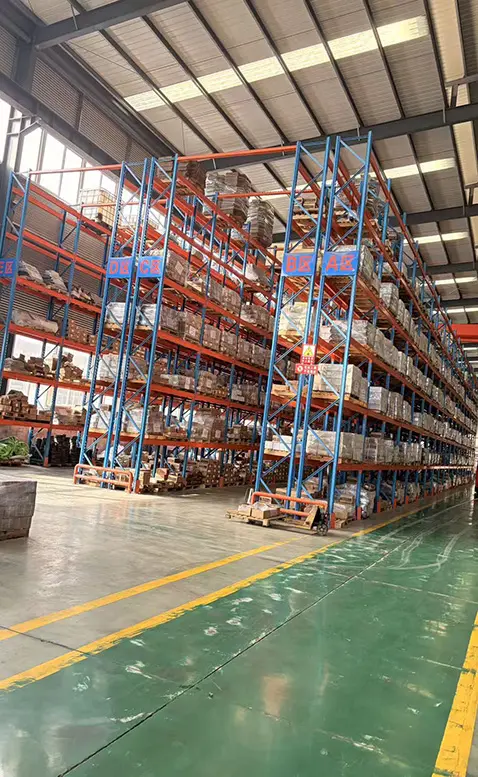
| Selective Pallet Racking | 800mm - 1,100mm (32"-44") | 2,300mm - 3,900mm | 3,000mm - 3,800mm (Standard) | Baseline (100%) | 100% Direct Access |
| Drive-In Racking | Custom Lane Depth (3-10 Pallets) | 1,350mm - 1,450mm (Clear) | Forklift Drives Inside Lane | Very High (+75%) | Low (LIFO Flow) |
| Push Back Racking | 2 to 6 Pallets Deep | 2,300mm - 2,700mm | 3,000mm - 3,400mm | High (+55%) | Medium (LIFO per Lane) |
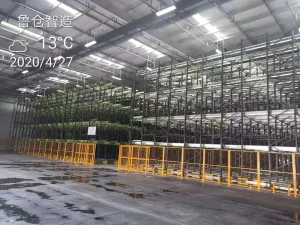
| Radio Shuttle Racking | Deep Lane (up to 40 Pallets) | 1,400mm - 1,500mm (Track) | Outer Aisle Only (2,800mm) | Maximum (+85%) | High (FIFO or LIFO) |
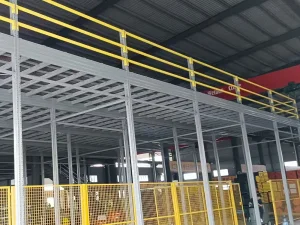
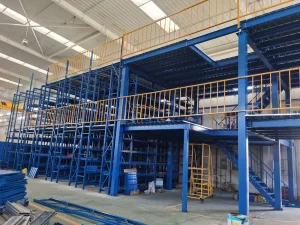
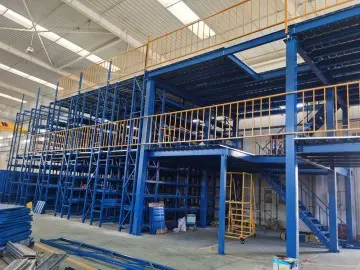
| Steel Platform Mezzanine | Custom Structural Columns | 3,000mm - 6,000mm Grid | N/A (Multi-Level Floor) | Floor Space Doubled (+100%) | 100% Manual Access |
| Cantilever Racking | 600mm - 1,500mm Arm Length | 1,000mm - 2,000mm Column Space | Depends on Load Length | Specialized (Long Goods) | 100% Side Load |
Warehouse storage rack procurement is shifting towards automation compatibility and sustainable manufacturing. Modern enterprise buyers must factor these three critical trends into their dimensional specifications.
Automated Storage and Retrieval Systems (AS/RS) utilize high-speed crane stackers operating inside rack structures up to 30 meters tall. Dimensional tolerances are strictly controlled within ±1.5mm to prevent stacker crane sensors from tripping during high-speed pallet placement.
Autonomous Guided Vehicles (AGVs) and Autonomous Mobile Robots (AMRs) require precise floor-level rack beam clearances and magnetic/optical line-of-sight paths. Bottom beam elevations are set to a minimum of 200mm to allow AMR under-chassis clearance.
Leading suppliers in China are transitioning to scrap-recycled Electric Arc Furnace (EAF) steel and zero-VOC electrostatic powder coatings, reducing embodied carbon footprints and supporting European CBAM (Carbon Border Adjustment Mechanism) environmental compliance.
Clear answers to common structural engineering, custom manufacturing, and global shipping questions faced by warehouse facility managers and procurement specialists.
Submit your facility CAD floor plan, unit load specs, or target storage pallet count to Guake Logistics Technology. Our structural engineers will return a complete 3D rack layout, load calculation profile, and wholesale direct factory quotation within 24 hours.